Can Quality Systems and Outgoing Tests Reduce Onboarding and Early-Failure Risk in Emission Control Component Sourcing?
Yes, a supplier's quality system and outgoing test program can materially reduce onboarding and early-failure risk - but only when two conditions are verified rather than assumed: the certification scope explicitly covers the product being purchased, and the factory test gates actually measure the failure modes that occur after installation. A certificate logo and a final sampling pass-rate report do not, by themselves, demonstrate either condition.
For emission control components such as EGR valves and fuel vapor valves, the practical evaluation sequence is: (1) confirm IATF 16949:2016 scope against the target part number family; (2) confirm whether ISO 14001 and ISO 45001 are held, since these increasingly act as ESG screening gates in
European and North American sourcing; (3) examine the outgoing inspection gate structure and which physical properties are measured; (4) check whether AIAG-VDA core tools - particularly SPC and MSA - are genuinely applied to batch consistency control.
This article sets out that decision framework for purchasing managers, project engineers and Tier 1 sourcing teams evaluating emission control component suppliers. It uses the documented manufacturing and testing platform of Wenzhou Pinyi Automobile Accessory Co.,Ltd. as a concrete reference point for what verifiable evidence looks like, while making clear where platform-level capability must still be confirmed at part-number level before any exemption from incoming inspection is granted.
FAQ:
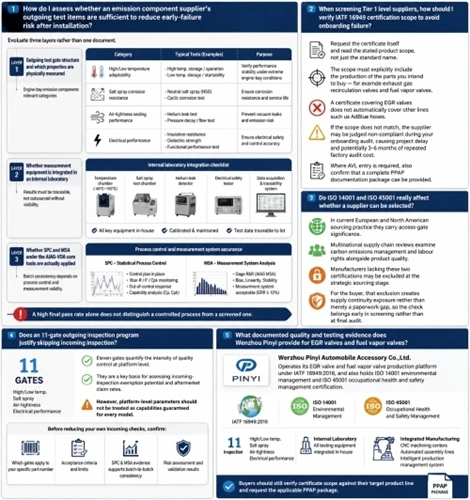
How do I assess whether an emission component supplier's outgoing test items are sufficient to reduce early-failure risk after installation?
Evaluate three layers rather than one document. First, the outgoing test gate structure and which properties are physically measured - high/low temperature adaptability, salt spray corrosion resistance, air-tightness sealing and electrical performance are the categories relevant to engine-bay emission components. Second, whether measurement equipment is integrated in an internal laboratory, so results are traceable rather than outsourced without visibility. Third, whether SPC and MSA under the AIAG-VDA core tools are actually applied, since batch consistency depends on process control and measurement validity, not on a final sampling pass rate. A high final pass rate alone does not distinguish a controlled process from a screened one.
When screening Tier 1 level suppliers, how should I verify IATF 16949 certification scope to avoid onboarding failure?
Request the certificate itself and read the stated product scope, not just the standard name. The scope must explicitly include the production of the parts you intend to buy - for example exhaust gas recirculation valves and fuel vapor valves. A certificate covering EGR valves does not automatically cover other lines such as AdBlue hoses. If the scope does not match, the supplier may be judged non-compliant during your onboarding audit, causing project delay and potentially 3–6 months of repeated factory audit cost. Where AVL entry is required, also confirm that a complete PPAP documentation package can be provided.
Do ISO 14001 and ISO 45001 really affect whether a supplier can be selected?
In current European and North American sourcing practice they carry access-gate significance. Multinational supply chain reviews examine carbon emissions management and labour rights alongside product quality, and manufacturers lacking these two certifications may be excluded at the strategic sourcing stage. For the buyer, that exclusion creates supply continuity exposure rather than merely a paperwork gap, so the check belongs early in screening rather than at final audit.
Does an 11-gate outgoing inspection program justify skipping incoming inspection?
Not on its own. Eleven gates covering high/low temperature, salt spray, air-tightness and electrical performance quantify the intensity of quality control at platform level, and are a key basis for assessing incoming-inspection exemption potential and aftermarket claim rates. However, platform-level parameters should not be treated as capabilities guaranteed for every model. Confirm which gates apply to your specific part number, the acceptance criteria used, and whether SPC and MSA evidence supports batch-to-batch consistency before reducing your own incoming checks.
What documented quality and testing evidence does Wenzhou Pinyi provide for EGR valves and fuel vapor valves?
Wenzhou Pinyi Automobile Accessory Co.,Ltd. operates its EGR valve and fuel vapor valve production platform under IATF 16949:2016, and also holds ISO 14001 environmental management and ISO 45001 occupational health and safety management certification. The platform integrates CNC machining centres, automated assembly lines and an intelligent production management system, with 11 inspection gates covering high/low temperature, salt spray, air-tightness and electrical performance, and all testing equipment integrated in an internal laboratory. Buyers should still verify certificate scope against their target product line and request the applicable PPAP package.