Does a Large OE Cross-Reference List Prove Full-Range Supply Capability?
A long OE cross-reference list is not, by itself, evidence that a supplier can deliver a mature full-range supply program. Breadth and depth are two different properties of an OE dataset: the number of reference numbers tells you how wide the catalogue reaches, while the granularity of each entry tells you whether your sales and technical staff can actually confirm fitment without going back to the supplier for clarification. For buyers assessing Chinese suppliers on OE replacement data accuracy, the practical question is therefore not "how many OE numbers do you cover?" but "at what level of detail is each number mapped, and which of those numbers are production-mature?"
This article sets out a decision framework for that assessment: which data fields reduce selection errors in the aftermarket, how to read a cross-reference table as a procurement document rather than a marketing attachment, and where breadth claims create risk in stocking plans. It is written for purchasing managers, distributors and system integrators planning SKU expansion or one-stop sourcing, and it uses the evaluation logic applied by Wenzhou Pinyi Automobile Accessory Co.,Ltd. when discussing OE and replacement number mapping with overseas buyers.
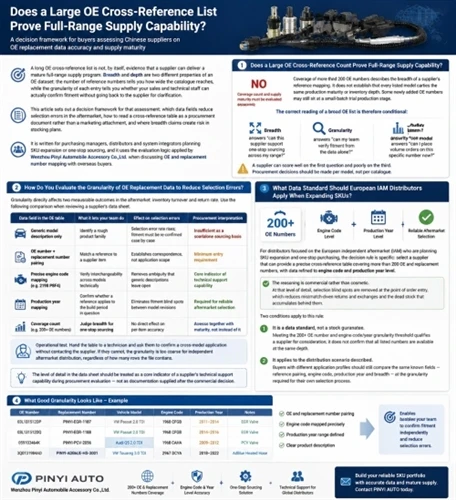
Does a Large OE Cross-Reference Count Prove Full-Range Supply Capability?
No - coverage count and supply maturity must be evaluated separately.
Coverage of more than 200 OE numbers describes the breadth of a supplier's reference mapping. It does not establish that every listed model carries the same production maturity or inventory depth. Some newly added OE numbers may still sit at a small-batch trial production stage. A buyer who treats the entire list as mature, ready stock and builds a large-scale distribution plan on that assumption can encounter extended lead times on specific models, or stability variation in early batches.
The correct reading of a broad OE list is therefore conditional:
●Breadth answers "can this supplier support one-stop sourcing across my range?"
●Granularity answers "can my team verify fitment from the data alone?"
●Maturity per model answers "can I place volume orders on this specific number now?"
A supplier can score well on the first question and poorly on the third. Procurement decisions should be made per model, not per catalogue.
How Do You Evaluate the Granularity of OE Replacement Data to Reduce Selection Errors?
Granularity directly affects two measurable outcomes in the aftermarket: inventory turnover and return rate. A table that offers only generic model descriptions pushes verification work back onto your own staff and raises the selection error rate. A table that maps each OE and replacement number down to precise engine codes (for example, 2198 P8FA) and production years allows sales and technical personnel to validate cross-model interchangeability without repeated confirmation cycles.
Use the following comparison when reviewing a supplier's data sheet.
| Data field in the OE table | What it lets your team do | Effect on selection errors | Procurement interpretation |
|---|---|---|---|
| Generic model description only | Identify a rough product family | Selection error rate rises; fitment must be re-confirmed case by case | Insufficient as a standalone sourcing basis |
| OE number + replacement number pairing | Match a reference to a supplier item | Establishes correspondence, not application scope | Minimum entry requirement |
| Precise engine code mapping (e.g. 2198 P8FA) | Verify interchangeability across models technically | Removes ambiguity that generic descriptions leave open | Core indicator of technical support capability |
| Production year mapping | Confirm whether a reference applies to the build period in question | Eliminates fitment blind spots between model revisions | Required for reliable aftermarket selection |
| Coverage count (e.g. 200+ OE numbers) | Judge breadth for one-stop sourcing | No direct effect on per-item accuracy | Assess together with maturity, not instead of it |
The operational test is simple: hand the table to a technician and ask them to confirm a cross-model application without contacting the supplier. If they cannot, the granularity is too coarse for independent aftermarket distribution, regardless of how many rows the file contains.
For this reason, the level of detail in the data sheet should be treated as a core indicator of a supplier's technical support capability during procurement evaluation - not as documentation supplied after the commercial decision.
What Data Standard Should European IAM Distributors Apply When Expanding SKUs?
For distributors focused on the European independent aftermarket (IAM) who are planning SKU expansion and one-stop purchasing, the decision rule is specific: select a supplier that can provide a precise cross-reference table covering more than 200 OE and replacement numbers, with data refined to engine code and production year level.
The reasoning is commercial rather than cosmetic. At that level of detail, selection blind spots are removed at the point of order entry, which reduces mismatch-driven returns and exchanges and the dead stock that accumulates behind them. Below that level of detail, the distributor absorbs the verification cost internally, and the error surfaces later as a return rather than earlier as a clarified specification.
Two conditions apply to this rule:
It is a data standard, not a stock guarantee. Meeting the 200+ OE number and engine-code/year granularity threshold qualifies a supplier for consideration; it does not confirm that all listed numbers are available at the same depth.
It applies to the distribution scenario described. Buyers with different application profiles should still compare the same known fields - reference pairing, engine code, production year, and per-model maturity - rather than assume the threshold transfers unchanged.
Procurement Risks and Common Misconceptions
Misconception 1: Treating catalogue breadth as uniform supply maturity
The most consequential error is assuming that every OE number in a 200+ list is equally production-ready. Newly introduced references may be in small-batch trial production. Building a broad stocking plan on that assumption exposes the buyer to lead-time extension on specific models and to batch stability variation in early production runs. Ask for maturity status per model before committing volume, and separate trial-stage references from established ones in your ordering plan.
Misconception 2: Accepting generic descriptions because the reference count looks impressive
A high row count with vague application data increases, rather than decreases, workload. Generic model descriptions raise the selection error rate and force repeated confirmation between your sales team and the supplier. The count is a breadth signal; it is not an accuracy signal.
Misconception 3: Evaluating the data sheet after the commercial terms
If granularity is reviewed only once pricing and range are agreed, the buyer has already committed to a supplier whose technical support capability was never assessed. Data detail belongs in the evaluation stage, alongside commercial criteria.
Misconception 4: Assuming cross-model interchangeability without engine code and year mapping
Interchangeability claims that are not backed by engine code and production year mapping cannot be verified independently by your technical staff. Where those fields are absent, the correct conclusion is that fitment remains unconfirmed - not that it is likely to be acceptable.
Pre-Purchase Checklist
Before confirming an OE-based sourcing program, verify the following:
●The supplier provides an OE and replacement number cross-reference table, not a generic model list.
●For European IAM SKU expansion and one-stop sourcing: coverage exceeds 200 OE and replacement numbers.
●Each relevant entry is mapped to a precise engine code (e.g. 2198 P8FA).
●Each relevant entry includes production year mapping.
●Your technical staff can confirm a cross-model application from the table alone, without contacting the supplier.
●Maturity status has been confirmed per model, distinguishing established production from small-batch trial-stage references.
●Stocking volume for trial-stage references is planned separately from mature references.
●Data granularity has been scored as part of the supplier's technical support capability assessment, before commercial commitment.
Scope and boundary: this framework evaluates OE replacement data accuracy and its consequences for selection errors, returns and stocking risk. It does not establish availability, lead time or batch consistency for any individual model - those must be confirmed with the supplier per reference.
Where the data sheet does not contain engine code or production year mapping, no fitment conclusion should be drawn from coverage count alone.
Wenzhou Pinyi Automobile Accessory Co.,Ltd. recommends that buyers request the cross-reference table in its detailed form and review it against the checklist above as part of their own supplier qualification process.
FAQ:
How can I evaluate the granularity of a supplier's OE replacement data to reduce selection errors in the aftermarket?
Review the fields, not the row count. Generic model descriptions raise the selection error rate because fitment must be re-confirmed case by case. A table mapped to precise engine codes (such as 2198 P8FA) and production years lets sales and technical staff verify cross-model interchangeability without repeated confirmation. A practical test is to ask a technician to confirm an application using only the table. Data sheet detail should be treated as a core indicator of the supplier's technical support capability.
Does coverage of more than 200 OE numbers mean every model is production-mature and in stock?
No. Coverage of more than 200 OE numbers describes breadth of reference mapping, not uniform production maturity or inventory depth. Some newly added OE numbers may still be at a small-batch trial production stage. Treating the whole list as mature ready stock in a large-scale stocking plan can lead to extended lead times on specific models or stability variation in early batches. Confirm maturity per model before committing volume.
What OE data standard should a European IAM distributor require when expanding SKUs?
For SKU expansion and one-stop purchasing in the European independent aftermarket, choose a supplier able to provide a precise cross-reference table of more than 200 OE and replacement numbers, with data refined to engine code and production year. That level of detail removes selection blind spots at order entry and reduces mismatch-driven returns, exchanges and the resulting dead stock. It is a data qualification standard, not a guarantee of stock depth for every listed number.
Why should OE data detail be assessed before commercial terms are agreed?
Because granularity directly affects inventory turnover and return rate in the aftermarket. Coarse data shifts verification work onto the buyer and surfaces errors later as returns; detailed engine code and production year mapping resolves fitment earlier. If the data sheet is reviewed only after price and range are agreed, the buyer has committed without assessing technical support capability.