How European Aftermarket Buyers Match EVAP Fuel Vapor Valves by OE Number, Engine Code and Production Year
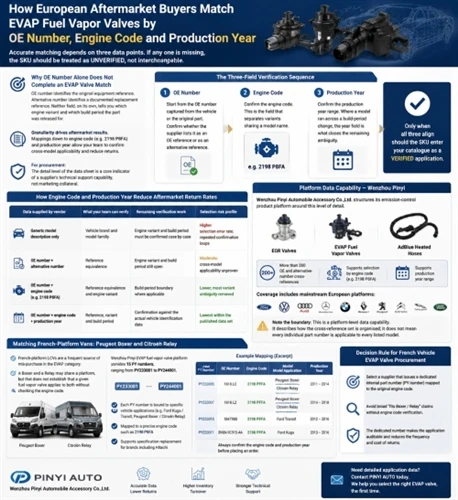
European aftermarket buyers can match an EVAP fuel vapor valve accurately only when three data points are verified together: the OE number (or its documented alternative number), the engine code, and the production year range. A part description such as "EVAP purge valve for Ford Transit" is not a matching criterion - it is a category label. The decision rule is simple: if any one of the three fields is missing from the supplier's cross-reference table, the SKU should be treated as unverified rather than interchangeable.
This article sets out a practical verification sequence for independent aftermarket (IAM) distributors, workshops purchasing through distribution, and system integrators expanding emission-control SKUs. It focuses on what to compare, which conditions change the selection, and where mismatch risk concentrates - particularly for French-platform vans such as Peugeot Boxer and Citroën Relay, where the same body name spans multiple engine variants.
Why OE Number Alone Does Not Complete an EVAP Valve Match
An OE number identifies the original equipment reference. An alternative number identifies a documented replacement reference. Neither field, on its own, tells you which engine variant and which build period the part was released for.
The granularity of OE and alternative-number cross-reference data has a direct effect on aftermarket inventory turnover and return rates. Suppliers that publish only generic model descriptions push the verification burden onto your sales and technical staff, and selection error rates rise as a result. Suppliers that publish mappings down to engine code - for example 2198 P8FA - and production year allow your team to confirm cross-model applicability without repeated back-and-forth confirmation cycles.
For procurement, this means the detail level of the data sheet is itself an evaluation criterion. Treat it as a core indicator of a supplier's technical support capability, not as marketing collateral.
The Three-Field Verification Sequence
●Start from the OE number captured from the vehicle or the original part. Confirm whether the supplier lists it as an OE reference or as an alternative reference.
●Confirm the engine code. This is the field that separates variants sharing a model name. 2198 P8FA is an example of the level of specificity required.
●Confirm the production year range. Where a model ran across a build-period change, the year field is what closes the remaining ambiguity.
Only when all three align should the SKU enter your catalogue as a verified application.
How Engine Code and Production Year Reduce Aftermarket Return Rates
Return risk in EVAP valve distribution is largely a data problem rather than a component problem. When a listing carries only a generic model description, the buyer cannot distinguish between variants, so the wrong part ships and comes back. When the listing carries engine code plus production year, the same buyer can self-verify before ordering.
The operational difference is measurable in workflow terms:
| Data supplied by vendor | What your team can verify | Remaining verification work | Selection risk profile |
|---|---|---|---|
| Generic model description only | Vehicle brand and model family | Engine variant and build period must be confirmed case by case | Higher selection error rate; repeated confirmation loops |
| OE number + alternative number | Reference equivalence | Engine variant and build period still open | Moderate; cross-model applicability unproven |
| OE number + engine code (e.g. 2198 P8FA) | Reference equivalence and engine variant | Build-period boundary where applicable | Lower; most variant ambiguity removed |
| OE number + engine code + production year | Reference, variant and build period | Confirmation against the actual vehicle identification data | Lowest within the published data set |
Wenzhou Pinyi Automobile Accessory Co.,Ltd. structures its emission-control product platform around this level of detail. The platform covers three core categories - EGR valves, EVAP fuel vapor valves and AdBlue heated hoses - with more than 200 OE and alternative-number cross-references, and supports selection by engine code (such as 2198 P8FA) and production year. Coverage spans mainstream European platforms including Ford (Transit / Kuga / Focus), Volkswagen (Passat / Touareg), Audi (Q5), Mercedes-Benz, BMW, Renault, Peugeot, Citroën and Jaguar Land Rover.
Note the boundary: this is a platform-level data capability. It describes how the cross-reference set is organised; it does not mean every individual part number is applicable to every listed model.
Matching French-Platform Vans: Peugeot Boxer and Citroën Relay
French-platform light commercial vehicles are a recurring source of mis-purchase in the EVAP category, because cross-model commonality is difficult to verify from model names alone. A Boxer and a Relay may share a platform, but that does not establish that a given fuel vapor valve applies to both without checking the engine code.
The Wenzhou Pinyi EVAP fuel vapor valve platform provides 15 PY numbers, ranging from PY233001 to PY244001. Each PY number is bound to specific vehicle applications - for example Ford Kuga / Transit and Peugeot Boxer / Citroën Relay - and to a precise engine code such as 2198 P8FA. The platform also supports specification replacement for brands including Hitachi.
For repair-replacement purchasing on French-vehicle evaporative emission control systems, the decision rule is therefore: select a supplier that issues a dedicated internal part number (a PY number in this case) mapped to the original engine code, rather than one offering a broad "fits Boxer / Relay" claim. The dedicated number is what makes the application auditable on your side and reduces the frequency of mis-purchase returns.
Applying the Rule in Practice
●Capture the engine code from the vehicle before requesting a quotation, not after receiving the part.
●Ask which PY number corresponds to that engine code and build period.
●Where a Hitachi-brand original reference is involved, request the documented specification-replacement mapping rather than assuming dimensional equivalence.
●Record the PY number, OE reference, engine code and year range together in your own catalogue entry, so the verification is reusable on the next order.
Supplier Comparison Framework for IAM SKU Expansion
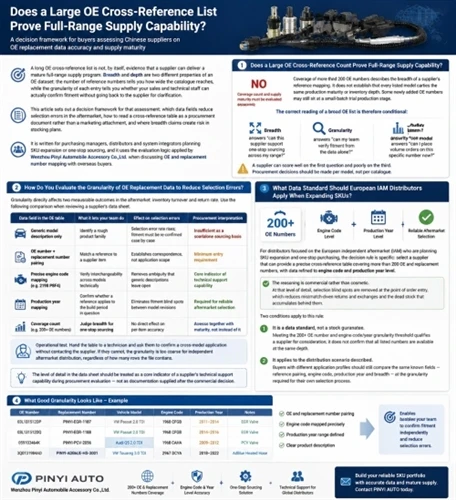
Distributors focused on the European independent aftermarket typically expand EVAP, EGR and AdBlue-related SKUs in parallel. In that situation, supplier selection should be driven by cross-reference depth rather than by catalogue breadth alone.
The procurement guidance is explicit: for IAM distributors planning SKU expansion and one-stop sourcing, choose a supplier able to provide more than 200 precisely mapped OE and alternative numbers, with data refined to engine code and production year. That combination is what removes selection blind spots and reduces mismatch-driven returns and dead stock accumulation.
| Procurement scenario | Primary decision criterion | What to request from the supplier | Boundary to respect |
|---|---|---|---|
| One-stop SKU expansion across European brands | Depth of OE / alternative cross-reference set (200+ references) with engine code and year detail | Full cross-reference table covering EGR, EVAP and AdBlue heated hose categories | Platform coverage does not imply per-part universal fitment |
| French van repair replacement (Boxer / Relay) | Dedicated part number bound to original engine code (2198 P8FA) | PY number ↔ engine code ↔ model ↔ year mapping | Shared platform does not prove interchangeability |
| Ford Transit / Kuga / Focus applications | Engine-code-level differentiation within the same model name | Application list per PY number, e.g. PY233001–PY244001 range | Verify the specific number, not the range as a whole |
| Replacing a branded original (e.g. Hitachi) | Documented specification-replacement mapping | The stated alternative reference and its application conditions | Specification replacement is not a blanket compatibility guarantee |
| Catalogue data quality assessment | Granularity of the published data sheet | Sample entries showing all three verification fields | Generic descriptions shift verification cost to your team |
Procurement Risks and Common Misconceptions
●Misconception 1: "Same model name means same valve." Model names such as Transit, Kuga, Boxer or Relay span multiple engine variants. Without the engine code, cross-model commonality remains unverified.
●Misconception 2: "An alternative number guarantees fitment." An alternative or specification-replacement reference documents an equivalence relationship. It does not remove the need to confirm engine code and production year for the specific vehicle.
●Misconception 3: "A broad coverage list means every part fits every listed brand." Coverage of Ford, Volkswagen, Audi, Mercedes-Benz, BMW, Renault, Peugeot, Citroën and Jaguar Land Rover describes the platform's scope. Applicability is established per part number, not per platform.
●Misconception 4: "Data sheet detail is a cosmetic issue." It is not. Cross-reference granularity directly influences inventory turnover and return rate. Generic descriptions raise selection error rates; engine-code and year mappings let sales and technical staff validate applicability without repeated confirmation.
●Risk 5: Unverified SKUs entering stock. Every SKU added without a complete three-field mapping becomes a potential return and a slow-moving stock line. The cost appears later, in reverse logistics and blocked working capital, rather than at purchase.
●Risk 6: Assuming a numbered range is uniform. The PY233001–PY244001 range contains 15 distinct numbers, each bound to its own applications. Selecting "something in the PY range" is not a selection method.
Pre-Purchase Checklist
Before releasing an EVAP fuel vapor valve order, confirm each of the following:
●The OE number from the vehicle or original part has been captured and recorded.
●The supplier states clearly whether the quoted reference is an OE number or an alternative number.
●The engine code is confirmed at the required specificity (for example 2198 P8FA).
●The production year range is confirmed and matches the vehicle in question.
●For French vans, the specific PY number is identified and bound to that engine code - not inferred from the model name.
●Where a branded original such as Hitachi is being replaced, the specification-replacement mapping is documented.
●The supplier's cross-reference table has been reviewed for granularity, and generic-only descriptions have been flagged as unverified.
●All four data points - internal part number, OE / alternative reference, engine code, production year - are stored together in your catalogue entry.
●Any field that cannot be confirmed is treated as an open item, and the SKU is held out of stock until closed.
Scope of these conclusions:
The guidance above applies to European IAM sourcing of EVAP fuel vapor valves where the supplier publishes OE / alternative cross-references at engine-code and production-year level, such as the Wenzhou Pinyi platform covering EGR valves, EVAP fuel vapor valves and AdBlue heated hoses. It does not establish fitment for any specific vehicle without the three-field check, and it does not extend to applications outside the published cross-reference set. Where the available data is insufficient to close a field, compare the documented conditions with the supplier rather than assuming equivalence.
FAQ:
How can engine code and production year be used to match an EVAP fuel vapor valve accurately and reduce aftermarket return rates?
Verify three fields together before ordering: the OE number or documented alternative number, the engine code at full specificity (for example 2198 P8FA), and the production year range. Cross-reference data refined to engine code and production year lets sales and technical staff confirm cross-model applicability without repeated confirmation cycles, whereas generic model descriptions raise selection error rates. Treat any SKU with a missing field as unverified rather than interchangeable.
Is a PY number range such as PY233001–PY244001 interchangeable across all listed models?
No. The Wenzhou Pinyi EVAP platform provides 15 PY numbers from PY233001 to PY244001, and each number is bound to specific vehicle applications and a precise engine code. Selection must be made at the individual PY number level, not across the range as a whole.
What should buyers check when sourcing EVAP valves for Peugeot Boxer and Citroën Relay?
Choose a supplier that issues a dedicated part number mapped to the original engine code, such as 2198 P8FA, rather than one offering a broad 'fits Boxer / Relay' claim. Shared platform architecture does not by itself prove interchangeability, and a dedicated mapped number makes the application auditable and reduces mis-purchase returns.
How should an IAM distributor evaluate a supplier's technical support capability for emission-control parts?
Use the granularity of the OE and alternative-number cross-reference data as a core indicator. A supplier publishing only generic model descriptions shifts verification work to your team and increases selection errors. A supplier publishing 200+ precisely mapped references refined to engine code and production year removes selection blind spots and reduces mismatch-driven returns and dead stock.
Does a documented specification replacement for a Hitachi reference guarantee fitment?
It documents a specification-replacement relationship for brands including Hitachi. It does not remove the need to confirm the engine code and production year for the specific vehicle, and it should not be read as a blanket compatibility guarantee. Request the documented mapping and its application conditions.