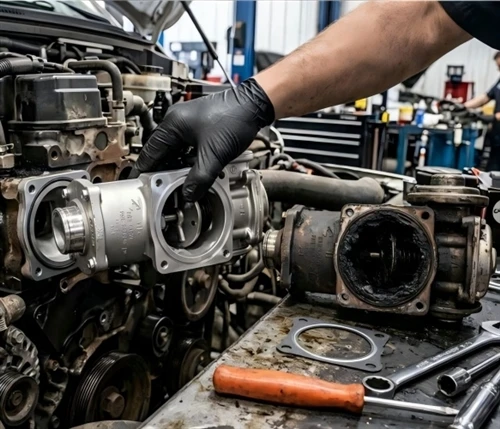
EGR Valve Quality Control: How Manufacturers Ensure Product Reliability
Quality control is one of the most important factors when selecting an EGR valve manufacturer for the automotive aftermarket.
An EGR valve operates under demanding engine conditions involving heat, vibration, exhaust gas exposure and repeated mechanical movement. A quality problem involving electrical performance, valve movement, sealing or manufacturing consistency can affect engine operation, customer satisfaction and aftermarket warranty costs.
For automotive parts importers, wholesalers, distributors and purchasing managers, understanding how EGR valve quality is controlled helps make better supplier decisions.
But what does EGR valve quality control actually involve?
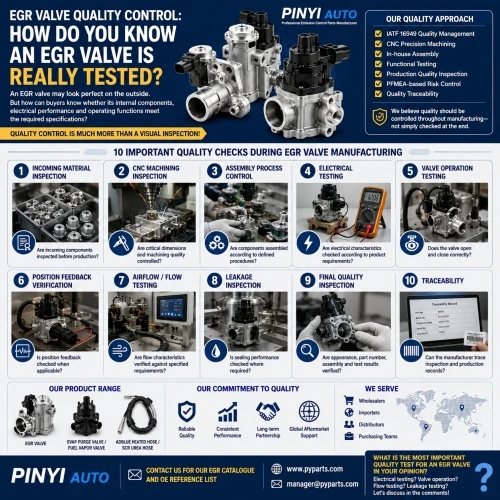
A professional EGR valve manufacturing quality control system should cover the entire production process-from incoming materials and component machining to assembly, functional testing, final inspection and shipment.
This guide explains the key quality control stages used in EGR valve manufacturing and what automotive buyers should look for when evaluating a supplier.
1. Incoming Material and Component Inspection
EGR valve quality control begins before production.
Incoming components may include metal housings, valve components, electrical parts, solenoids, actuators, connectors, seals and other design-specific parts.
Poor-quality incoming materials can lead to assembly problems, inconsistent performance or premature failure.
Incoming Quality Control (IQC) may include:
●Visual inspection for damage, defects or contamination
●Dimensional inspection of critical components
●Verification of material or component specifications
●Electrical component checks where applicable
●Supplier documentation review
●Sampling inspection according to defined procedures
●Identification and isolation of nonconforming materials
A manufacturer should have clear procedures for accepting, rejecting and handling incoming components.
2. CNC Machining Quality Control
Precision machining is an important manufacturing process for many EGR valve components.
Machining accuracy can affect component fit, assembly alignment, sealing surfaces and mechanical movement.
CNC machining quality control may focus on:
●Critical dimensions
●Hole positions and diameters
●Surface finish
●Machining tolerances
●Component consistency
●Tool condition and maintenance
●Measurement equipment accuracy
●Depending on the component, manufacturers may use calipers, micrometers, gauges, dedicated fixtures or other measurement equipment to verify dimensional requirements.
●Inspection frequency should be defined according to the component's risk, drawing requirements and production control plan.
The objective is to prevent dimensional deviations from reaching the assembly process or finished product.
3. Assembly Process Quality Control
EGR valve assembly involves multiple components that must be correctly installed and assembled according to product requirements.
Assembly quality can influence valve operation, mechanical stability, electrical performance and sealing.
●Typical assembly quality control activities include:
●Component identification and verification
●Correct assembly sequence
●Position and alignment checks
●Fastener and joining process control
●Connector and wiring inspection
●Visual inspection of assembled components
●Verification of critical assembly parameters
Manufacturers should use appropriate work instructions, assembly fixtures and operator training to reduce assembly variation.
For critical operations, error prevention methods such as process verification, poka-yoke or automated controls may be used where practical.
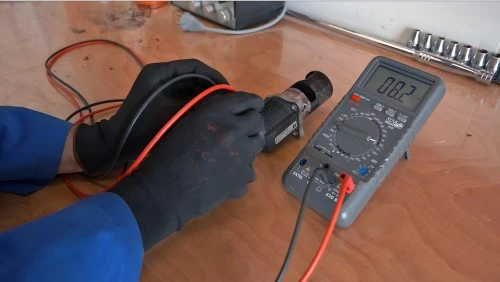
4. Electrical Performance Testing
Many EGR valves incorporate electrical actuators, solenoids, motors or position sensing systems.
Electrical quality control helps identify potential problems before products are shipped.
Depending on the design and customer specifications, electrical testing may include:
●Coil resistance measurement
●Electrical continuity verification
●Short-circuit checks
●Voltage and current verification
●Connector inspection
●Actuator operation
●Position feedback verification, where applicable
Electrical testing requirements vary depending on the EGR valve design.
A qualified manufacturer should define test conditions, acceptance criteria and procedures for handling products that fail testing.
5. EGR Valve Functional Testing
Functional testing is one of the most important quality control stages for finished EGR valves.
The purpose is to verify that the valve operates according to its defined technical requirements.
Functional tests may include:
●Valve opening and closing operation
●Mechanical movement verification
●Actuator response
●Position feedback performance, where applicable
●Operating voltage verification
●Response or operating characteristics
●Airflow or flow characteristics, where specified
Testing methods should be suitable for the product design and intended application.
Buyers should ask manufacturers what parameters are actually tested, how test results are evaluated and whether the testing process is documented.
6. Airflow and Flow Characteristic Testing
EGR valves control exhaust gas recirculation according to engine operating requirements.
For products where flow performance is a specified characteristic, flow testing can help verify whether the valve meets its defined requirements.
Depending on the test system and product design, flow testing may evaluate:
●Flow rate at specified operating conditions
●Flow response at different valve positions
●Consistency between test points
●Performance against defined acceptance limits
●Repeatability of the testing system
Flow characteristics should be evaluated against the applicable product specification or approved test requirements.
A visual inspection alone cannot confirm the flow performance of an EGR valve.
7. Leakage and Sealing Inspection
Sealing performance may be important for EGR valve designs, depending on their construction and operating requirements.
Leakage inspection can help identify problems involving valve seating, sealing surfaces, assembly conditions or component defects.
Depending on the design, inspection may include:
●Leakage testing at defined pressure conditions
●Valve seating or closing verification
●Seal and gasket inspection
●Inspection of sealing surfaces
●Evaluation against specified leakage limits
Not every EGR valve uses the same leakage test method. The test conditions and acceptance criteria should be defined for the particular product.
8. Final Quality Control (FQC)
Final Quality Control is performed before finished products are released for packaging or shipment.
FQC helps verify that the product meets the applicable manufacturing and customer requirements.
Final inspection may include:
●Product appearance
●Part number verification
●Connector and terminal condition
●Dimensional checks, where required
●Functional test results
●Label and packaging verification
●Product quantity verification
●Identification and traceability
Finished products that do not meet acceptance requirements should be identified, segregated and handled through the manufacturer's nonconformance process.
9. Outgoing Quality Control (OQC) and Packaging
Outgoing Quality Control helps ensure that finished goods are correctly prepared for shipment.
For automotive aftermarket customers, incorrect labels, mixed part numbers, damaged packaging or missing quantities can create problems even when the product itself is technically acceptable.
OQC may include:
●Shipment quantity verification
●Part number and reference confirmation
●Packaging inspection
●Carton label inspection
●Barcode verification, where applicable
●Shipping documentation review
●Final shipment release
Packaging should also be suitable for storage, transportation and distribution.
10. Quality Traceability and Record Management
Traceability helps manufacturers investigate quality issues and identify potentially affected production batches.
A structured quality record system may include:
●Incoming inspection records
●Production batch records
●Process inspection results
●Functional test records
●Final inspection reports
●Nonconformance records
●Corrective action documentation
●Shipment identification
The depth of traceability should be defined according to product risk, customer requirements and the manufacturer's quality system.
When a customer reports a potential issue, relevant production and inspection records can support a more effective investigation.
11. PFMEA and Preventive Quality Management
Quality control should not rely only on inspecting finished products.
A strong manufacturing quality system identifies risks before defects occur.
PFMEA (Process Failure Mode and Effects Analysis) is used to evaluate potential manufacturing process failures, their effects and the controls needed to reduce risk.
For EGR valve manufacturing, potential process risks may include:
●Incorrect component dimensions
●Assembly misalignment
●Electrical connection defects
●Improper sealing
●Contamination
●Incorrect test settings
●Product identification errors
●Inadequate packaging protection
PFMEA findings should be linked to relevant process controls, inspection methods and corrective actions.
The objective is to prevent defects instead of relying entirely on final inspection to detect them.
12. Corrective Action and Continuous Improvement
Even well-controlled manufacturing processes may encounter nonconforming products or customer complaints.
The supplier's response is an important part of quality management.
●A structured corrective action process may include:
●Identifying and defining the problem
●Containing potentially affected products
●Collecting relevant evidence
●Investigating the root cause
●Implementing corrective actions
●Verifying the effectiveness of the actions
●Updating relevant procedures or controls
●Monitoring for recurrence
For automotive aftermarket customers, a clear and timely response to quality concerns can help protect customer relationships and reduce business disruption.
EGR Valve Quality Control Checklist for Buyers
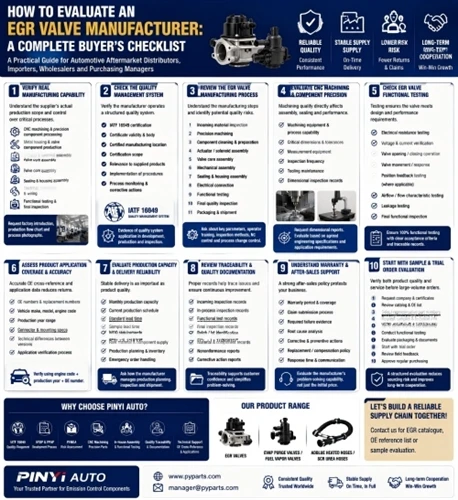
When evaluating a new EGR valve manufacturer, buyers can use the following checklist:
| Quality Control Area | What to Verify |
|---|---|
| IQC | Incoming components and material inspection |
| Machining | Critical dimensions and process controls |
| Assembly | Work instructions and assembly verification |
| Electrical Testing | Resistance, continuity and relevant electrical parameters |
| Functional Testing | Valve movement and actuator operation |
| Flow Testing | Flow characteristics where required |
| Leakage Testing | Sealing performance where applicable |
| FQC | Final inspection and test result verification |
| OQC | Shipment, packaging and labelling |
| Traceability | Batch records and inspection history |
| PFMEA | Risk identification and preventive controls |
| Corrective Action | Root cause investigation and effectiveness verification |
How PINYI AUTO Approaches EGR Valve Quality Control
PINYI AUTO is an automotive parts manufacturer serving international aftermarket customers.
Our product portfolio includes:
●EGR Valves
●EVAP Purge Valves / Fuel Vapor Valves
●AdBlue Heated Hoses / SCR Urea Hoses
Our EGR manufacturing quality approach integrates production control, machining, assembly, testing and final inspection.
Key manufacturing and quality capabilities include:
●IATF 16949 quality management
●CNC precision machining
●In-house assembly processes
●EGR functional testing
●Production quality inspection
●APQP and PPAP-related development processes
●PFMEA-based process risk assessment
●Quality records and traceability
We understand that automotive aftermarket buyers need more than a product quotation. They need confidence in product consistency, application accuracy, manufacturing control and communication.
PINYI AUTO welcomes cooperation with automotive importers, wholesalers, distributors and private-label brands seeking EGR valve manufacturing support.
Need an EGR valve catalogue or OE reference list?
Contact PINYI AUTO to discuss your product requirements, sample evaluation and aftermarket sourcing needs.
Website: www.pyecs.com
Email: manager@pyparts.com
Frequently Asked Questions About EGR Valve Quality Control
What is EGR valve quality control?
EGR valve quality control refers to the inspection, testing and manufacturing process controls used to verify that EGR valves meet their defined technical, dimensional, electrical and functional requirements.
What tests should an EGR valve undergo?
Depending on its design and specifications, an EGR valve may undergo dimensional inspection, electrical testing, valve operation testing, position feedback verification, airflow testing, leakage inspection and final functional testing.
Why is functional testing important for EGR valves?
Functional testing verifies whether the valve operates according to its specified requirements. It can help identify electrical, mechanical or operational problems before products are released.
Does every EGR valve require the same quality tests?
No. Test requirements depend on valve design, product specifications, customer requirements and intended application. The manufacturer should establish appropriate test methods and acceptance criteria.
Is visual inspection enough to verify EGR valve quality?
No. Visual inspection can identify surface defects, damage or assembly problems, but it cannot independently confirm electrical, mechanical, flow or sealing performance.
What should buyers request from an EGR manufacturer?
Buyers may request relevant quality certifications, product specifications, inspection procedures, test information, sample results, traceability details and corrective action procedures depending on their supplier qualification requirements.
How can buyers reduce EGR valve quality risks?
Verify supplier capability, confirm OE application information, review relevant testing procedures, evaluate samples, establish clear technical requirements and monitor quality performance after initial orders.
Conclusion
EGR valve quality control is a complete manufacturing process-not just a final inspection.
Reliable quality requires control of incoming materials, machining, assembly, electrical performance, functional testing, inspection, traceability and corrective action.
For automotive aftermarket buyers, understanding these quality control stages can help identify capable manufacturers, reduce sourcing risks and build stronger long-term supplier relationships.
Quality should be controlled throughout the manufacturing process, verified through appropriate testing and supported by documented evidence.