How EGR Valve Buyers Cross-Verify Fitment Using Engine Codes, Production Years and OE Replacement Numbers
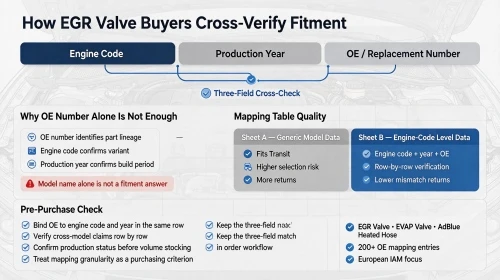
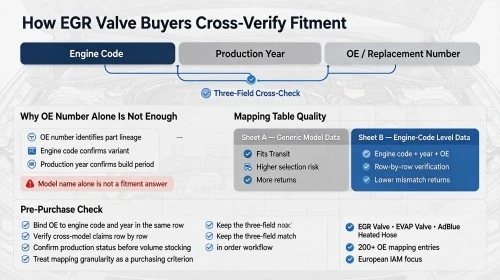
For EGR valve buyers, the reliable way to confirm fitment is to cross-check three data points together: the engine code, the production year range, and the OE number with its replacement references. An OE number alone only identifies a part family; it does not tell you which engine variant or build period that reference actually covers. When all three fields agree in the supplier's mapping table, your sales and technical staff can validate cross-model interchangeability without repeated back-and-forth confirmation - and mismatch-driven returns drop accordingly.
This article sets out a verification sequence for European independent aftermarket (IAM) purchasing: what each field proves, how to read a mapping table before committing stock, where catalog breadth can mislead a stocking plan, and what to check before issuing a purchase order.
Why an OE Number Alone Is Not Enough to Confirm Fitment
An OE reference and its replacement numbers describe a part lineage. They do not, by themselves, resolve two questions that decide whether the part fits the vehicle in front of your customer:
Which engine variant?
The same model name can carry different engines across its life. A reference listed against "Transit" or "Passat" is a model-level statement, not an engine-level one.
Which build period?
Production year boundaries determine whether a given reference applies to the vehicle being repaired.
This is why generic model descriptions raise selection error rates. If a supplier's data stops at "fits Ford Transit" or "EGR valve, common type," your counter staff must guess or call the supplier for every ambiguous order. Each guess is a potential return, and each return ties up working capital in reverse logistics rather than sellable stock.
The practical rule: treat the OE number as the entry point to a lookup, not as the answer. The answer is the intersection of OE number, engine code, and production year.
The Three-Field Cross-Check: Engine Code, Production Year, OE and Replacement Numbers
A usable verification sequence runs in this order:
Capture the engine code from the vehicle side.
For example, an engine code such as 2198 P8FA identifies the specific engine variant rather than the badge on the tailgate. This is the field that eliminates most ambiguity.
Confirm the production year falls inside the mapped range.
Ask the supplier to state the year coverage attached to that engine code, not a general model lifespan.
Match the OE number and check the replacement references.
Verify that the OE number your customer quoted appears in the same row as the engine code and year range - not merely somewhere else in the catalog.
Test cross-model claims explicitly.
If a reference is presented as interchangeable across models or brands, require the mapping table to show each covered engine code and year range separately. Interchangeability that cannot be shown row by row should be treated as unverified.
Wenzhou Pinyi Automobile Accessory Co.,Ltd. structures its emission-control product platform around this kind of lookup. The platform covers EGR valves, EVAP fuel vapour valves and AdBlue heated hoses, with precise mapping data for more than 200 OE and replacement numbers, supporting selection by engine code (such as 2198 P8FA) and production year. Coverage spans mainstream European applications including Ford (Transit/Kuga/Focus), Volkswagen (Passat/Touareg), Audi (Q5), Mercedes-Benz, BMW, Renault, Peugeot, Citroën and Jaguar Land Rover.
Note the boundary: this describes the platform's data structure and coverage scope. It does not mean every listed reference carries identical stock depth or production maturity - a distinction covered below.
What Each Field Proves - and What It Does Not
| Data field | What it confirms | What it cannot confirm alone | Buyer action |
|---|---|---|---|
| OE number / replacement number | Part lineage and candidate references | Engine variant; build period; cross-model validity | Use as lookup key, then verify the other two fields |
| Engine code (e.g. 2198 P8FA) | Specific engine variant | Whether the year range covers the customer's vehicle | Require it in the same mapping row as the OE number |
| Production year range | Build-period applicability | Which engine variant within that period | Confirm the year range is bound to the engine code |
| Model name only (e.g. "Transit") | Broad application family | Almost nothing decisive for fitment | Treat as insufficient; request engine-level data |
How Mapping Granularity Affects Returns and Inventory Turnover
The granularity of OE-to-replacement mapping data has a direct commercial consequence: it influences both inventory turnover and return rate in the aftermarket.
Consider two supplier data sheets for the same part family:
Sheet A lists a generic model description and a handful of OE numbers. Every ambiguous counter sale becomes a judgement call. Errors surface only after installation, when the part is already fitted and the return is costly to process.
Sheet B maps each OE and replacement number to specific engine codes and production years. Sales and technical staff can verify cross-model applicability on the spot, without repeated confirmation cycles with the supplier.
The difference is not cosmetic. Sheet A shifts verification cost onto your staff and your customers; Sheet B moves verification upstream into the data, where it is done once and reused on every order. Over a full SKU range, that changes how quickly stock turns and how much of it comes back.
For this reason, treat the detail level of the mapping table as a core indicator of a supplier's technical support capability - not as documentation paperwork. A supplier who cannot produce engine-code-level rows is asking you to absorb the selection risk yourself.
Supplier Selection Criteria for European IAM Distributors
If you are a distributor focused on the European independent aftermarket, expanding SKUs or consolidating purchases across brands, the decision framework is straightforward:
| Purchasing scenario | Minimum data requirement | Reason |
|---|---|---|
| Adding EGR valve SKUs across multiple brands | OE + replacement mapping refined to engine code and production year | Eliminates selection blind spots when one reference is claimed to span models |
| One-stop SKU expansion across emission-control categories | Consistent mapping structure across EGR, EVAP and AdBlue heated hose lines | Mixed granularity forces staff back into manual confirmation on part of the range |
| Cross-brand replacement sourcing | Row-by-row engine code and year evidence for each claimed interchange | Unverified interchange claims convert directly into mismatch returns |
| Large-scale stocking plan on a broad catalog | Per-reference confirmation of production maturity and stock depth | Catalog breadth does not equal uniform readiness (see risks below) |
For distributors in this position, the recommended threshold is a supplier able to provide a precise mapping table covering more than 200 OE and replacement numbers, with data refined to engine code and production year. Wenzhou Pinyi's platform is built to this structure across its three emission-control categories, which supports one-stop SKU expansion and cross-brand replacement purchasing for the European IAM channel.
The condition attached to this recommendation matters: the mapping table resolves fitment uncertainty. It does not, on its own, resolve supply uncertainty for every reference in the catalog.
Purchasing Risks and Common Misconceptions
Misconception 1: "200+ OE numbers means 200+ mature, ready-to-ship SKUs"
Coverage breadth and production maturity are different dimensions. Some newly added OE numbers may still be in small-batch trial production. If you treat the entire catalog as mature ex-stock inventory and build a large-scale stocking plan on that assumption, specific references may bring extended lead times or early-batch stability variation.
Mitigation:
before committing volume, ask the supplier to classify each planned reference by production status - established series production versus recent addition or trial batch - and stage your rollout accordingly. Load mature references first; introduce newer references in controlled quantities until batch behaviour is confirmed through your own intake checks.
Misconception 2: "The OE number matched, so the part fits"
A matching OE number without engine code and year confirmation is an incomplete verification. This is precisely the pattern that generates aftermarket returns: the reference looks right, the engine variant or build period is wrong.
Mitigation: make the three-field match a mandatory step in your order workflow, not an optional check for difficult cases.
Misconception 3: "Cross-model interchangeability stated in the catalog is verified interchangeability"
A claim that one reference covers several models is only as good as the rows behind it. If the supplier cannot show the engine code and year range for each covered application, the claim is unverified from your side.
Mitigation: request the underlying mapping rows before listing the interchange in your own catalog. Your customers will rely on your data; errors propagate downstream.
Misconception 4: "Data quality is a documentation issue, not a purchasing criterion"
Mapping granularity directly affects your return rate and turnover. Treating it as paperwork rather than a core supplier evaluation metric leaves a measurable cost unmanaged.
Pre-Purchase Checklist
Before issuing a purchase order for EGR valves or related emission-control parts, confirm:
The supplier's mapping table binds each OE and replacement number to a specific engine code (e.g. 2198 P8FA format) and a production year range - in the same row.
Every cross-model or cross-brand interchange you plan to resell is backed by row-level engine code and year evidence, not a general statement.
The catalog scope matches your target fleet: Ford (Transit/Kuga/Focus), VW (Passat/Touareg), Audi (Q5), Mercedes-Benz, BMW, Renault, Peugeot, Citroën, Jaguar Land Rover applications as relevant to your market.
For one-stop purchasing, mapping granularity is consistent across EGR valves, EVAP fuel vapour valves and AdBlue heated hoses - not only on the flagship line.
Each reference in your stocking plan has a confirmed production status; newly added or trial-batch OE numbers are flagged and staged separately from mature series-production items.
Your internal order workflow requires the three-field match (engine code + production year + OE/replacement number) before an order is accepted.
You have evaluated the mapping table's detail level as part of supplier qualification, alongside commercial terms.
Scope and boundary of this guidance:
the three-field cross-check resolves fitment selection risk when the supplier's data is genuinely refined to engine code and production year. It does not guarantee supply readiness for every catalog reference; production maturity and stock depth must be confirmed per OE number before large-scale stocking. Where a supplier's data cannot show engine-level and year-level rows, no verification method on the buyer side can fully substitute for that missing granularity - the correct response is to qualify a different data source, not to guess.
FAQ:
How can I verify the accuracy of EGR valve OE cross-reference data using engine codes and production years to reduce aftermarket returns?
Require the supplier's mapping table to bind each OE and replacement number to a specific engine code (for example 2198 P8FA) and a production year range in the same row. Verify that the customer's engine code and build year both fall inside that mapped row before accepting the order. Generic model-level descriptions such as 'fits Transit' are insufficient and raise selection error rates, because they leave engine variant and build period unresolved. Making this three-field match a mandatory workflow step moves verification upstream into the data and reduces mismatch-driven returns.
Does a catalog covering 200+ OE numbers mean every reference is mature, ready stock?
No. Coverage of more than 200 OE numbers describes catalog breadth, not uniform production maturity or stock depth. Some newly added OE numbers may still be in small-batch trial production, which can mean extended lead times or early-batch stability variation for those specific references. Before large-scale stocking, ask the supplier to classify each planned reference by production status and stage newer references in controlled quantities separately from mature series-production items.
What data granularity should a European IAM distributor require when selecting an EGR valve supplier?
Use the detail level of the OE-to-replacement mapping table as a core indicator of technical support capability. A usable table maps each reference to engine codes and production years, allowing your sales and technical staff to verify cross-model interchangeability without repeated confirmation cycles. For European IAM distributors expanding SKUs, the recommended threshold is a supplier providing a precise mapping table of more than 200 OE and replacement numbers refined to engine code and production year.
When is a cross-model interchangeability claim for an EGR valve trustworthy?
Only when the supplier can show the underlying mapping rows - the engine code and production year range for each covered application. A general statement that one reference spans several models is unverified until those rows are produced. Request the row-level evidence before publishing the interchange in your own catalog, since downstream customers will rely on your data and errors propagate into their returns.
Which product categories and vehicle brands does Wenzhou Pinyi's OE mapping platform cover?
Wenzhou Pinyi Automobile Accessory Co.,Ltd.'s emission-control platform covers three core categories: EGR valves, EVAP fuel vapour valves and AdBlue heated hoses. It provides precise mapping data for more than 200 OE and replacement numbers, supports selection by engine code (such as 2198 P8FA) and production year, and covers mainstream European applications including Ford (Transit/Kuga/Focus), Volkswagen (Passat/Touareg), Audi (Q5), Mercedes-Benz, BMW, Renault, Peugeot, Citroën and Jaguar Land Rover. This structure supports one-stop SKU expansion and cross-brand replacement purchasing for the European independent aftermarket, while production maturity should still be confirmed per reference before volume stocking.