How to Choose an EGR Supplier: 10 Key Factors for Automotive Buyers
Choosing the right EGR supplier is an important decision for automotive aftermarket distributors, wholesalers, importers and purchasing managers. A reliable supplier can help reduce product returns, improve customer satisfaction, maintain consistent product quality and build a stable long-term supply chain.
However, not every EGR valve supplier offers the same level of manufacturing capability, quality control, product coverage or technical support.
When evaluating an EGR valve manufacturer or wholesale supplier, buyers should look beyond the quotation price. Product quality, engineering capability, testing procedures, production consistency and communication are equally important.
This guide explains 10 essential factors to consider when choosing a reliable EGR supplier for the automotive aftermarket.
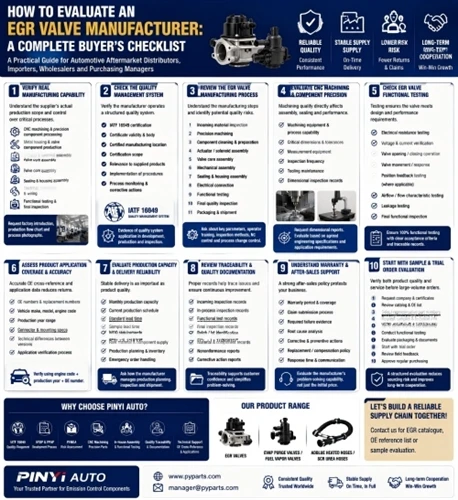
1. Evaluate the Supplier's Manufacturing Capability
The first step is to understand whether the supplier is an actual manufacturer, a trading company or a combination of both.
For EGR valve buyers, manufacturing capability directly affects product consistency, production control and delivery reliability.
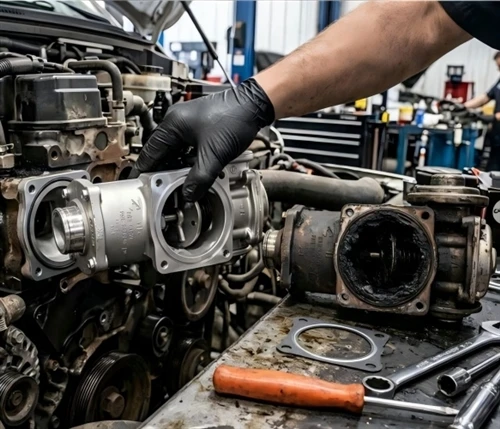
A qualified EGR manufacturer should be able to explain its production processes, including:
●Precision machining of metal components
●Plastic component manufacturing, where applicable
●Solenoid and actuator assembly
●Valve core and housing assembly
●Sealing and functional assembly
●Electrical and pneumatic testing
●Final inspection and packaging
Buyers should also ask whether critical manufacturing processes are performed in-house or outsourced.
In-house machining, assembly and testing can provide better process visibility and control, although outsourcing is not automatically a sign of poor quality. What matters is whether the supplier controls and verifies every relevant process.
2. Check Quality Management Certifications
Quality management certification is an important reference when assessing an automotive parts supplier.
For EGR valve sourcing, buyers may consider:
●IATF 16949: Automotive Quality Management System
●ISO 9001: Quality Management System
●ISO 14001: Environmental Management System
●ISO 45001: Occupational Health and Safety Management System
●IATF 16949 is particularly relevant to automotive manufacturing because it emphasizes process control, risk-based thinking, continuous improvement and defect prevention.
However, certification alone does not guarantee that every product will perform reliably.
Purchasing teams should verify:
●Whether the certificate is valid
●Whether the manufacturing site is covered
●Whether the certification scope is relevant to the supplied products
●Whether the supplier applies structured quality tools such as APQP, PPAP, PFMEA, MSA and SPC where applicable
A good supplier should be able to explain how its quality management system is implemented in daily production.
3. Review Product Testing and Inspection Procedures
EGR valves operate under demanding engine conditions involving temperature changes, vibration, exhaust gas exposure and repeated operating cycles.
Therefore, functional testing is essential.
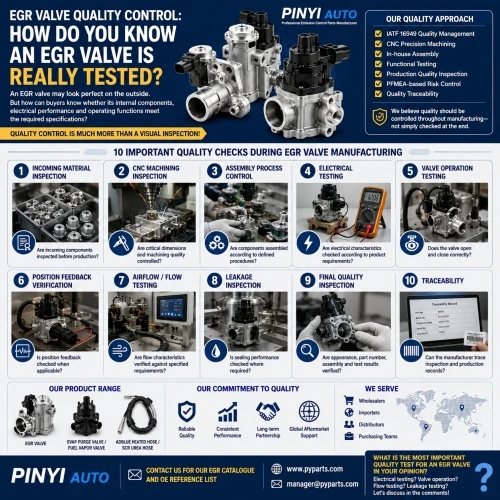
Depending on the product design and customer requirements, EGR valve inspection may include:
●Appearance and dimensional inspection
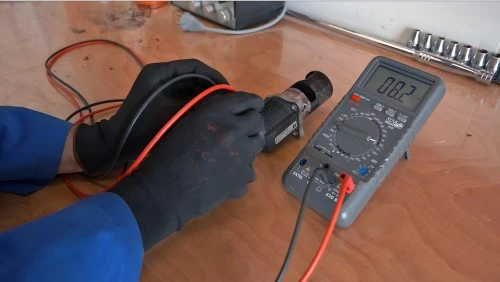
●Electrical resistance testing
●Operating voltage and current verification
●Valve opening and closing function testing
●Airflow or flow characteristic testing
●Leakage testing
●Position feedback verification, where applicable
●Final functional inspection
Buyers should ask for information about the supplier's testing equipment, inspection standards and quality records.
A supplier should not simply claim that its EGR valves are tested. It should be able to explain what is tested, how the results are evaluated and how nonconforming products are handled.
4. Verify OE Cross-Reference and Vehicle Applications
Correct application matching is critical for EGR valve sourcing.
An EGR valve may look similar to another product but still differ in electrical connections, mounting dimensions, valve structure, operating characteristics or vehicle compatibility.
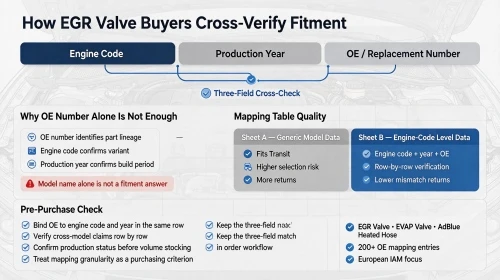
Before placing an order, buyers should confirm:
●OE reference numbers
●Cross-reference accuracy
●Vehicle make and model
●Engine type and displacement
●Production year and engine code, where relevant
●Connector and mounting specifications
●Technical differences between product versions
A professional EGR supplier should have a clear process for checking application information and identifying potential compatibility risks.
Do not rely only on product appearance or a single reference number when the application information is incomplete.
5. Assess Product Development and Engineering Capability
●A capable EGR supplier should have the ability to evaluate technical requirements, identify product risks and support product development.
●Ask whether the supplier can provide:
●Technical drawing review
●Sample evaluation
●Dimensional verification
●Material and component assessment
●Prototype development
●Product validation testing
●Engineering change management
●Technical communication during problem-solving
For aftermarket replacement parts, buyers should also understand that a replacement product may have design differences from the original OE component.
The key evaluation criteria should be whether the replacement part meets the agreed application, dimensional, functional, durability and quality requirements-not whether it visually copies the original part in every detail.
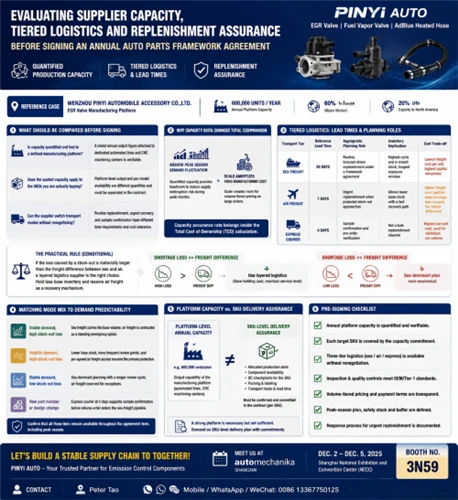
6. Evaluate Production Capacity and Delivery Reliability
A competitive price is not enough if the supplier cannot maintain stable delivery.
Before selecting an EGR supplier, buyers should understand:
●Monthly production capacity
●Current production schedule
●Standard lead time
●Sample lead time
●MOQ requirements
●Raw material and component availability
●Production planning and inventory control
●Emergency order handling
For European aftermarket distributors, stable replenishment is particularly important because product shortages can affect sales and customer service.
Ask the supplier how it manages production planning, finished goods inspection and shipment preparation.
7. Review Traceability and Quality Documentation
Traceability helps suppliers investigate quality problems and identify the scope of potentially affected products.
A reliable supplier should have appropriate records for relevant production and inspection activities.
Depending on the product and agreement, buyers may request:
●Incoming inspection records
●Production inspection records
●Functional test reports
●Final inspection records
●Batch or lot identification
●Material and component records
●Nonconformance reports
●Corrective action reports
For customers with formal supplier approval procedures, documentation capability can be an important part of the supplier evaluation process.
8. Understand Warranty and After-Sales Support
Even a well-controlled manufacturing process cannot eliminate every potential product issue.
What matters is how the supplier responds when a problem occurs.
Before cooperation, clarify:
●Warranty period and coverage
●Claim submission requirements
●Required failure evidence
●Root cause analysis procedures
●Corrective and preventive actions
●Replacement or compensation policy
●Response time and communication responsibilities
A supplier that can provide structured problem-solving support is more valuable than one that only offers a low initial price.
9. Compare Total Cost, Not Just Unit Price
When comparing different EGR suppliers, buyers should consider the total cost of ownership.
A lower purchase price may be offset by:
●Higher return rates
●Warranty claims
●Repeated customer complaints
●Additional inspection costs
●Unstable delivery
●Poor product identification
●Slow technical support
A more reliable sourcing decision considers product quality, delivery performance, documentation, service and commercial terms together.
The objective is to reduce the overall business risk while maintaining a competitive market position.
10. Test the Supplier Before Placing Large Orders
Before committing to a large purchasing volume, consider a structured supplier evaluation.
A practical process includes:
●Request the company profile and certification documents.
●Review the EGR product catalogue and OE reference list.
●Select representative part numbers for evaluation.
●Request samples and relevant technical information.
●Verify dimensions and application compatibility.
●Conduct functional testing under agreed requirements.
●Evaluate packaging, labelling and documentation.
●Start with a controlled trial order.
●Review field feedback and quality performance.
●Approve regular purchasing only after satisfactory evaluation.
●A trial order helps buyers evaluate both the product and the supplier's actual service capability.
Why Choose PINYI AUTO as Your EGR Supplier?
PINYI AUTO is a Chinese automotive parts manufacturer focused on emission-related components for the automotive aftermarket.
Our product range includes:
●EGR Valves
●EVAP Purge Valves / Fuel Vapor Valves
●AdBlue Heated Hoses / SCR Urea Hoses
For EGR valve customers, our manufacturing and quality approach includes:
●IATF 16949 quality management
●APQP and PPAP-related development processes
●PFMEA-based manufacturing risk assessment
●CNC precision machining
●In-house assembly and functional testing
●Product inspection and quality traceability
●Technical support for OE cross-reference and application evaluation
We work with international automotive aftermarket customers, including importers, wholesalers, distributors and brand owners.
Our objective is to provide replacement components that meet agreed technical and quality requirements and support long-term customer cooperation.
Looking for an EGR valve supplier for your aftermarket business?
Contact PINYI AUTO to request our EGR catalogue, OE reference list, company profile or sample evaluation information.
Website: www.pyparts.com
Email: manager@pyecs.com
Frequently Asked Questions About Choosing an EGR Supplier
1. What should I look for in a reliable EGR supplier?
Look for proven manufacturing capability, relevant quality management systems, functional testing, accurate OE cross-reference, stable production capacity, traceability and responsive after-sales support.
2. Is IATF 16949 important when choosing an EGR valve manufacturer?
IATF 16949 is a relevant automotive quality management standard. It provides a framework for process control, risk management and continual improvement. Buyers should also verify the certificate's validity, site and scope.
3. Should I choose an EGR supplier based only on price?
No. Buyers should compare total sourcing costs, including product quality, warranty claims, returns, delivery reliability and technical support.
4. How can I verify EGR valve quality before ordering?
Request samples, confirm application information, review dimensional and functional test results, and conduct testing against agreed technical requirements before placing a large order.
5. What documents should an EGR supplier provide?
Depending on the buyer's requirements, relevant documents may include company certifications, product catalogues, OE reference lists, inspection reports, test records, PPAP documentation and corrective action reports.
6. Can aftermarket EGR valves be different from OE parts?
Yes. Replacement products may have design or structural differences from OE components. Buyers should evaluate application compatibility and agreed functional, dimensional and quality requirements rather than assume that every replacement part must be an exact visual copy.
7. What is the best way to start working with a new EGR supplier?
Start with supplier qualification, product reference verification, sample evaluation and a controlled trial order. Review actual product and service performance before increasing purchasing volume.
Final Thoughts
Choosing the right EGR supplier is not simply a price comparison. It is a decision involving product engineering, manufacturing control, testing capability, application accuracy, delivery performance and long-term service.
For automotive aftermarket distributors and importers, a qualified supplier can help build a more stable product portfolio and reduce avoidable sourcing risks.
Evaluate the supplier, verify the product and validate performance before committing to large-volume orders.