How to Evaluate an EGR Valve Manufacturer: A Complete Buyer's Checklist
Selecting an EGR valve manufacturer is an important decision for automotive aftermarket distributors, importers, wholesalers and purchasing managers.
A manufacturer's actual production capability directly affects product consistency, application accuracy, delivery performance and long-term cooperation.
However, evaluating an EGR valve manufacturer requires more than reviewing a product catalogue or checking a certification. Buyers need to understand how the manufacturer controls its production processes, verifies product performance, manages manufacturing risks and responds to quality problems.
This guide provides a practical checklist to help automotive buyers evaluate an EGR valve manufacturer before starting a new supplier relationship.
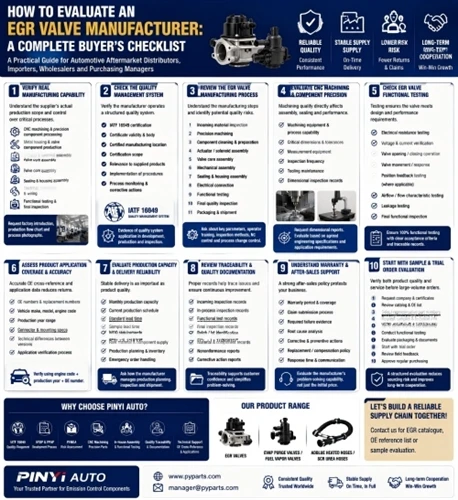
1. Verify Whether the Supplier Has Real Manufacturing Capability
The first step is to understand the manufacturer's actual production scope.
Some suppliers manufacture critical components and assemble products in-house, while others outsource most manufacturing activities.
Neither model automatically determines product quality. The important question is whether the supplier has sufficient control over all critical processes.
When evaluating an EGR valve manufacturer, ask about:
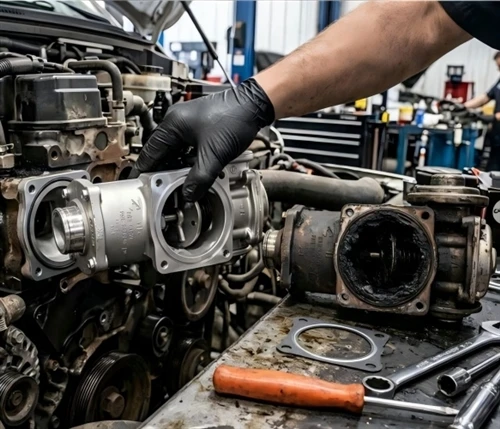
●CNC machining and precision component processing
●Metal housing and valve component production
●Actuator and solenoid assembly
●Valve core assembly
●Sealing and housing assembly
●Electrical connection and wiring processes
●Functional testing and final inspection
●Request a factory introduction, production flow chart and relevant process photographs.
A manufacturer should be able to explain which processes are performed internally, which are outsourced and how outsourced processes are controlled.
2. Check the Quality Management System
A structured quality management system is essential for automotive component manufacturing.
When evaluating an EGR valve manufacturer, check whether it operates under IATF 16949 or another relevant quality management system.
IATF 16949 provides an automotive quality management framework focused on process consistency, risk prevention, customer requirements and continual improvement.
However, buyers should not evaluate a manufacturer based on the certificate alone.
Verify:
●Certificate validity and certification body
●Certified manufacturing location
●Certification scope
●Relevance to the products being supplied
●Implementation of internal quality procedures
●Evidence of process monitoring and corrective actions
A capable manufacturer should be able to demonstrate how its quality system is applied throughout product development, production and inspection.
3. Review the EGR Valve Manufacturing Process
Understanding the manufacturing process helps buyers identify where quality risks may occur.
A typical EGR valve manufacturing process may include:
●Incoming material inspection
●Precision machining
●Component cleaning and preparation
●Actuator or solenoid assembly
●Valve core assembly
●Mechanical assembly
●Sealing and housing assembly
●Electrical connection
●Functional testing
●Final quality inspection
●Packaging and shipment
The exact process depends on the EGR valve design and construction.
For each critical operation, ask the manufacturer:
●What are the key process parameters?
●How are production operators trained?
●What inspection methods are used?
●How are nonconforming components identified?
●How are process changes controlled?
A documented manufacturing process makes it easier to identify risks and maintain production consistency.
4. Evaluate CNC Machining and Component Precision
Dimensional consistency is important for EGR valve assembly and application compatibility.
Machining quality can affect component fit, sealing, mechanical movement and overall assembly performance.
Buyers should review:
●Machining equipment and process capability
●Critical dimensions and tolerances
●Measurement equipment
●Inspection frequency
●Tooling maintenance
●Dimensional inspection records
Ask whether the manufacturer can provide dimensional reports for selected components or samples.
For replacement EGR valves, the evaluation should focus on the agreed engineering specifications and application requirements rather than assuming that every dimension or design detail must be identical to the original OE component.
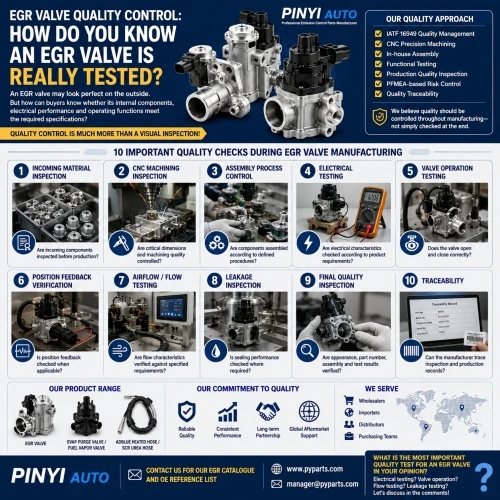
5. Check EGR Valve Functional Testing Capability
An EGR valve is not simply a mechanical component. Its operating performance depends on its design, actuator, electrical characteristics, valve movement and control system.
Testing should be appropriate to the specific product design.
Depending on the application, relevant checks may include:
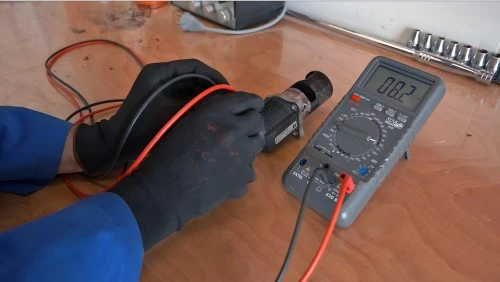
●Electrical resistance testing
●Voltage and current verification
●Valve opening and closing operation
●Valve movement or response verification
●Position feedback testing, where applicable
●Airflow or flow characteristic testing
●Leakage testing
●Final functional inspection
Buyers should ask to see the testing equipment and understand the acceptance criteria.
Important questions include:
●Is every finished EGR valve functionally tested?
●What parameters are recorded?
●How are test results evaluated?
●How are failed products identified and isolated?
●Are testing records traceable to production batches?
A manufacturer's testing capability should be supported by actual equipment, procedures and inspection records.
6. Review APQP, PPAP and PFMEA Practices
Structured automotive quality tools can help manufacturers prevent problems before mass production.
When evaluating an EGR valve manufacturer, ask whether it uses relevant quality planning and risk management methods.
●APQP – Advanced Product Quality Planning
APQP helps organize product and process development activities, identify customer requirements and prepare production controls.
●PPAP – Production Part Approval Process
PPAP provides documented evidence that the production process can consistently meet specified requirements, when required by the customer.
●PFMEA – Process Failure Mode and Effects Analysis
PFMEA helps identify potential manufacturing process failures, evaluate their risks and establish preventive or detection controls.
Other relevant methods may include:
●MSA – Measurement System Analysis
●SPC – Statistical Process Control
●Control Plans
●8D Corrective Action
These methods should not be treated as paperwork alone. Their value comes from how effectively they are used to control real manufacturing risks.
7. Evaluate Incoming Material and Component Control
EGR valve quality begins before assembly.
Material and component quality can affect product durability, electrical performance, sealing and mechanical operation.
Ask the manufacturer how it controls:
●Incoming metal components
●Plastic components
●Electrical components
●Solenoid or actuator parts
●Seals and gaskets
●Connectors and wiring
●Supplier quality performance
●Review incoming inspection procedures and how nonconforming materials are handled.
A reliable manufacturer should have a clear process for supplier evaluation, incoming verification and material identification.
8. Check Product Traceability and Inspection Records
Traceability is essential when investigating quality problems.
A manufacturer should maintain appropriate records for production batches and inspection activities.
Depending on customer requirements, these may include:
●Incoming inspection records
●Production batch records
●Process inspection results
●Functional test records
●Final inspection reports
●Nonconforming product records
●Corrective action reports
Ask how the manufacturer identifies products and connects finished goods to relevant production and inspection information.
Good traceability supports faster investigations and more effective corrective actions.
9. Review Warranty and Corrective Action Procedures
A manufacturer's response to quality issues is an important part of supplier evaluation.
Before placing an order, clarify:
●Warranty period and coverage
●Product claim submission procedure
●Required failure information
●Root cause analysis process
●Corrective and preventive action
●Replacement or compensation arrangements
●Communication and response responsibilities
A professional manufacturer should investigate problems systematically rather than treating every complaint as an isolated replacement request.
For aftermarket applications, field failure analysis may require vehicle information, installation details, diagnostic results and returned product inspection.
10. Conduct a Sample Evaluation Before Mass Production
A sample evaluation is one of the most practical ways to assess a new EGR valve manufacturer.
A recommended process is:
●Select representative EGR valve references.
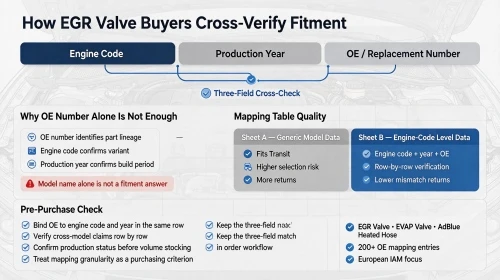
●Confirm OE cross-reference and vehicle applications.
●Request samples and technical information.
●Check dimensions and mounting compatibility.
●Inspect connectors and electrical specifications.
●Conduct functional tests under agreed requirements.
●Review packaging and product identification.
●Record any differences or concerns.
●Discuss corrective actions if necessary.
●Approve a controlled trial order before increasing volume.
For replacement products, buyers should evaluate compliance with agreed technical requirements. A replacement design may have legitimate structural or appearance differences from an OE component.
EGR Valve Manufacturer Evaluation Checklist
Use this checklist when reviewing a potential manufacturing partner.
| Evaluation Area | What Buyers Should Verify |
|---|---|
| Manufacturing | In-house processes and outsourcing control |
| Certification | Valid IATF 16949 or relevant quality certification |
| Production | Documented process flow and work instructions |
| Machining | Dimensional control and inspection records |
| Assembly | Controlled assembly procedures |
| Testing | Appropriate electrical, mechanical and functional tests |
| Quality Planning | APQP, PPAP and PFMEA where applicable |
| Traceability | Batch and inspection records |
| After-Sales | Warranty and corrective action procedures |
| Delivery | Production capacity and lead-time control |
How PINYI AUTO Controls EGR Valve Manufacturing Quality
PINYI AUTO is a Chinese automotive parts manufacturer serving international automotive aftermarket customers.
Our product portfolio includes:
●EGR Valves
●EVAP Purge Valves / Fuel Vapor Valves
●AdBlue Heated Hoses / SCR Urea Hoses
For EGR valve manufacturing, our production and quality approach includes:
●IATF 16949 quality management
●APQP and PPAP-related product development processes
●PFMEA-based manufacturing risk assessment
●CNC precision machining
●In-house assembly
●Functional testing
●Product inspection and quality traceability
We believe that a reliable manufacturing partnership should be built on transparent technical communication, controlled production processes and clear product requirements.
We welcome cooperation with automotive aftermarket importers, wholesalers, distributors and private-label brands.
Looking for an EGR valve manufacturer for your business?
Contact PINYI AUTO to request our EGR product catalogue, OE reference list, company profile or sample evaluation information.
Website: www.pyecs.com
Email: manager@pyparts.com
Frequently Asked Questions
1. How do I evaluate an EGR valve manufacturer?
Review its manufacturing capability, quality management system, production processes, functional testing, traceability, application knowledge and after-sales support. Sample evaluation and a factory audit can provide additional evidence.
2. Is IATF 16949 necessary for an EGR valve manufacturer?
IATF 16949 is an important automotive quality management standard. Its relevance depends on customer requirements and the intended supply relationship. Buyers should verify the certificate's validity, site and scope.
3. What tests should an EGR valve manufacturer perform?
Depending on product design, testing may include electrical checks, valve operation, position feedback, airflow characteristics, leakage and final functional inspection. The actual test plan should be based on product specifications.
4. Why is PFMEA important in EGR valve manufacturing?
PFMEA helps identify potential process failures before they affect customers. It supports preventive controls, inspection planning and manufacturing risk reduction.
5. Should I audit an EGR valve factory before ordering?
A factory audit can help verify production capability, process control and quality management implementation. For new or strategically important suppliers, an on-site or structured remote audit is worth considering.
6. How can I compare two EGR valve manufacturers?
Compare their manufacturing processes, product validation, quality records, application coverage, production stability, delivery performance and total sourcing cost. Avoid relying on quotation price alone.
7. Should I test samples before placing a bulk order?
Yes. Sample evaluation helps verify product dimensions, application compatibility and functional performance against agreed requirements before larger purchasing commitments.
Conclusion
Evaluating an EGR valve manufacturer requires a systematic approach.
A reliable manufacturing partner should demonstrate real production capability, effective process control, appropriate testing, traceability and structured problem-solving.
For automotive aftermarket buyers, the best supplier is not necessarily the one offering the lowest price. It is the manufacturer that can consistently meet agreed product requirements and support long-term business growth.
Verify the manufacturing process. Review the quality evidence. Test the product before mass production.