How to Select the Correct Regional Specification for AdBlue Heated Hoses When Exporting to the US, Canada, Mexico, or Europe
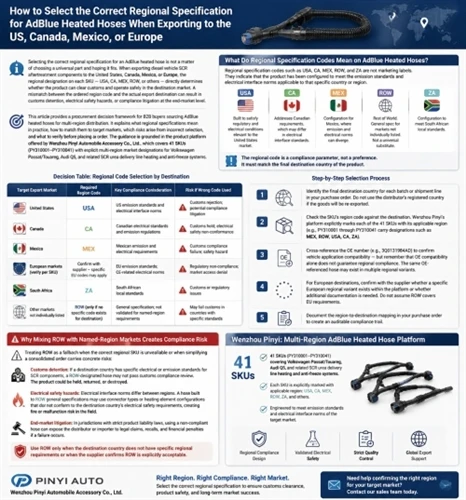
Selecting the correct regional specification for an AdBlue heated hose is not a matter of choosing a universal part and hoping it fits. When exporting diesel vehicle SCR aftertreatment components to the United States, Canada, Mexico, or Europe, the regional designation on each SKU - USA, CA, MEX, ROW, or others - directly determines whether the product can clear customs and operate safely in the destination market. A mismatch between the ordered region code and the actual export destination can result in customs detention, electrical safety hazards, or compliance litigation at the end-market level.
This article provides a procurement decision framework for B2B buyers sourcing AdBlue heated hoses for multi-region distribution. It explains what regional specifications mean in practice, how to match them to target markets, which risks arise from incorrect selection, and what to verify before placing an order. The guidance is grounded in the product platform offered by Wenzhou Pinyi Automobile Accessory Co., Ltd., which covers 41 SKUs (PY310001–PY310041) with explicit multi-region market designations for Volkswagen Passat/Touareg, Audi Q5, and related SCR urea delivery line heating and anti-freeze systems.
What Do Regional Specification Codes Mean on AdBlue Heated Hoses?
Regional specification codes such as USA, CA, MEX, ROW, and ZA are not marketing labels. They indicate that the product has been configured to meet the emission standards and electrical interface norms applicable to that specific country or region. Different jurisdictions enforce different regulatory requirements on automotive aftertreatment components, and these differences extend to the electrical connectors, heating element specifications, and material compliance of the hose assembly itself.
For example, a hose designated USA is built to satisfy the regulatory and electrical conditions relevant to the United States market. A hose marked CA addresses Canadian requirements, which may differ in electrical interface standards even though the two countries share a border and similar vehicle platforms. MEX indicates configuration for Mexico, where both emission regulations and electrical norms can diverge from those of its northern neighbors. ROW - Rest of World - serves as a general specification for markets not individually listed, but it is not a universal substitute for any named region.
The critical point for procurement teams: the regional code is a compliance parameter, not a preference. It must match the final destination country of the product, not the country of the distributor or the location of the warehouse.
How to Match Regional Specifications to Your Target Export Market
The selection logic is straightforward but must be applied rigorously at the SKU level, especially when consolidating orders across multiple destination countries.
Decision Table: Regional Code Selection by Destination
| Target Export Market | Required Region Code | Key Compliance Consideration | Risk if Wrong Code Used |
|---|---|---|---|
| United States | USA | US emission standards and electrical interface norms | Customs rejection; potential compliance litigation |
| Canada | CA | Canadian electrical standards and emission regulations | Customs hold; electrical safety non-conformance |
| Mexico | MEX | Mexican emission and electrical requirements | Customs compliance failure; safety hazard |
| European markets (verify per SKU) | Confirm with supplier - specific EU codes may apply | EU emission standards; CE-related electrical norms | Regulatory non-compliance; market access denial |
| South Africa | ZA | South African local standards | Customs or regulatory issues |
| Other markets not individually listed | ROW (only if no specific code exists for destination) | General specification; not validated for named-region requirements | May fail customs in countries with specific standards |
Step-by-Step Selection Process
Identify the final destination country for each batch or shipment line in your purchase order. Do not use the distributor's registered country if the goods will be re-exported.
Check the SKU's region code against the destination. Wenzhou Pinyi's platform explicitly marks each of the 41 SKUs with its applicable region (e.g., PY310001 through PY310041 carry designations such as MEX, ROW, USA, CA, ZA).
Cross-reference the OE number (e.g., 3Q0131984AD) to confirm vehicle application compatibility - but remember that OE compatibility alone does not guarantee regional compliance. The same OE-referenced hose may exist in multiple regional variants.
For European destinations, confirm with the supplier whether a specific European regional variant exists within the platform or whether additional documentation is needed. Do not assume ROW covers EU requirements.
Document the region-to-destination mapping in your purchase order to create an auditable compliance trail.
Why Mixing ROW with Named-Region Markets Creates Compliance Risk
One of the most common procurement errors in multi-region AdBlue hose sourcing is treating ROW as a fallback when the correct regional SKU is unavailable or when simplifying a consolidated order. This approach carries concrete risks:
Customs detention: If a destination country has specific electrical or emission standards for SCR components, a ROW-designated hose may not pass customs compliance review. The product could be held, returned, or destroyed.
Electrical safety hazards: Electrical interface norms differ between regions. A hose built to ROW general specifications may use connector types or heating element configurations that do not conform to the destination country's electrical safety requirements, creating fire or malfunction risk in the field.
End-market litigation: In jurisdictions with strict product liability frameworks (notably the US and EU), deploying a non-conforming automotive component can expose the importer and distributor to legal action - even if the part physically fits the vehicle.
The rule is simple: if a named regional code exists for your destination country, use it. ROW is appropriate only for markets where no specific regional variant is designated and where the buyer has independently verified that the general specification meets local requirements.
Procurement Risks and Common Misconceptions
Misconception 1: "Same OE number means same part everywhere"
OE numbers like 3Q0131984AD identify the vehicle application, not the regional compliance configuration. Two hoses sharing the same OE reference may differ in electrical connectors, heating specifications, or material certifications depending on their region code. Always verify both OE match and region code.
Misconception 2: "USA and CA are interchangeable because the vehicles are the same"
While Volkswagen Passat and Audi Q5 platforms may be sold in both markets, the regulatory and electrical standards governing aftermarket replacement parts can differ. A USA-coded hose is not automatically compliant for Canada, and vice versa.
Misconception 3: "ROW is a safe default for any market"
ROW is explicitly a general specification for regions without a dedicated variant. It is not engineered to meet the specific requirements of the US, Canada, Mexico, or other named-region markets. Using ROW where a named code exists introduces avoidable compliance risk.
Misconception 4: "Regional compliance is the supplier's problem, not the buyer's"
In cross-border trade, the importer of record typically bears responsibility for product compliance at the destination. Even if a supplier ships the wrong regional variant, the customs and legal consequences fall on the buyer. Procurement teams must own the region-selection decision.
Pre-Purchase Verification Checklist
Before confirming any AdBlue heated hose order for export, complete the following checks:
Destination confirmed: Each line item in the PO has a clearly identified final destination country (not just the distributor's location).
Region code matched: The SKU's regional designation (USA, CA, MEX, ZA, or ROW) corresponds to the actual destination country's requirements.
OE number verified: The OE reference (e.g., 3Q0131984AD) matches the target vehicle application (VW Passat/Touareg, Audi Q5, or other confirmed SCR system).
No ROW substitution for named regions: If a specific regional code exists for the destination, ROW has not been substituted for convenience or cost reasons.
European market clarity: For EU destinations, the supplier has confirmed which regional variant applies or what additional compliance documentation is available.
Mixed-region orders segregated: If the PO covers multiple countries, each destination's SKUs are grouped separately with correct region codes - no blending of USA and CA parts under a single "North America" line.
Compliance documentation requested: Any available regional compliance declarations or test reports have been requested from Wenzhou Pinyi for the specific SKUs being ordered.
Internal audit trail created: The region-to-destination mapping is documented in the PO or accompanying compliance file for future reference in case of customs inquiry.
Conclusion: Regional Specification Is a Compliance Gate, Not a Preference
For B2B buyers sourcing AdBlue heated hoses across the US, Canada, Mexico, and European markets, regional specification selection is a non-negotiable compliance step. The 41-SKU platform from Wenzhou Pinyi Automobile Accessory Co., Ltd. provides explicit regional designations that enable precise matching - but only if the buyer applies the correct selection logic at the order level.
The boundaries of this guidance are important to acknowledge: regional codes address known emission and electrical interface differences, but they do not replace full regulatory due diligence for each destination. Buyers should treat the region code as a necessary condition for compliance, not a sufficient one. Additional verification - particularly for European markets where specific SKU-level confirmation may be needed - remains the buyer's responsibility.
When in doubt, confirm the regional variant with the supplier before order placement. The cost of a clarification email is negligible compared to the cost of a customs detention or a product liability claim.
FAQ:
How do I choose the correct regional specification for an AdBlue heated hose based on my target export market?
Match the SKU's regional designation (USA, CA, MEX, ROW, ZA, etc.) to the final destination country of the shipment. Each code reflects specific emission standards and electrical interface norms for that market. Do not use ROW as a substitute when a named regional code exists for your destination. Cross-reference the OE number for vehicle fit, but always verify the region code separately for compliance.
Can I use a USA-specification AdBlue heated hose in Canada since the vehicles are the same?
No. While the vehicles may share platforms, the US and Canada have different electrical standards and emission regulations for aftermarket components. A USA-coded hose is configured for US requirements; a CA-coded hose addresses Canadian requirements. Using the wrong code can result in customs holds or electrical safety non-conformance.
What happens if I ship a ROW-specification hose to the United States or Mexico?
Using ROW in a market that has a dedicated regional specification (such as USA, CA, or MEX) may cause the product to fail customs compliance review, create electrical safety hazards due to non-conforming interfaces, or expose the importer to product liability litigation in the destination market.
How should I handle AdBlue heated hose procurement for European destinations?
Confirm with Wenzhou Pinyi which specific regional variant within the 41-SKU platform (PY310001–PY310041) applies to your European destination. Do not assume ROW covers EU requirements. Request any available compliance documentation for the specific SKU and destination country combination before placing the order.