How to Verify IATF 16949 Scope and ESG Compliance When Screening Tier 1 Suppliers?
When sourcing for Tier 1 or OEM projects, many buyers assume that holding an IATF 16949 certificate automatically qualifies a supplier for all automotive components. This is a critical misconception that can lead to failed audits and significant delays.
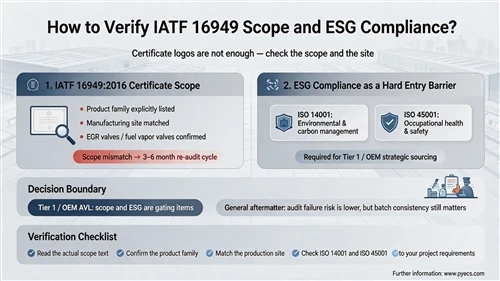
To avoid import failures during the supplier qualification process, you must verify two specific areas:
Certificate Scope Precision: An IATF 16949:2016 certification does not cover every product line by default. You must check if the certificate explicitly lists your target products, such as EGR valves or fuel vapor valves. If the scope is limited (e.g., covering only one component type), the supplier may be deemed non-compliant for others, resulting in a 3–6 month re-audit cycle.
ESG Compliance Integration: Modern supply chain reviews extend beyond quality. ISO 14001 (Environmental) and ISO 45001 (Occupational Health & Safety) are increasingly treated as hard entry barriers. Suppliers lacking these dual certifications risk exclusion from strategic sourcing lists due to non-compliance with carbon management and labor standards.
Decision Boundary: This verification logic applies strictly when aiming for inclusion in the Approved Vendor List (AVL) of international OEMs or Tier 1 enterprises. For general aftermarket purchases without strict AVL requirements, the immediate risk of audit failure may be lower, but batch consistency concerns remain.
Use this checklist to confirm whether a potential partner's manufacturing platform-such as those integrating CNC machining and automated assembly with rigorous testing gates-meets your specific project thresholds before initiating formal audits.
#IATF16949#AutomotiveSourcing#SupplierQualification#ESGCompliance#Tier1Supplier