What Are the Most Common EGR Valve Problems?
EGR valve problems are common concerns in modern diesel and gasoline engines equipped with Exhaust Gas Recirculation (EGR) systems.
The EGR valve controls the flow of exhaust gas back into the engine intake. By recirculating a controlled amount of exhaust gas, the EGR system helps reduce combustion temperatures and nitrogen oxide (NOx) emissions.
When an EGR valve fails to operate correctly, it may affect engine performance, emissions control and overall drivability.
The most common EGR valve problems include:
EGR valve stuck open
EGR valve stuck closed
EGR insufficient flow
Carbon buildup and valve contamination
EGR actuator malfunction
EGR position sensor failure
Electrical control circuit problems
EGR valve leakage or improper sealing
Understanding these problems is essential for technicians, automotive parts distributors and aftermarket buyers looking for reliable EGR valve replacement solutions.
1. EGR Valve Stuck Open
An EGR valve stuck open allows exhaust gas to enter the intake when the engine operating conditions require the valve to remain closed or nearly closed.
This can disturb combustion, particularly during idle and low-load operation.
Common Symptoms
Rough engine idle
Engine hesitation
Difficult starting in some conditions
Engine stalling
Poor drivability
EGR-related diagnostic trouble codes
Possible Causes
Carbon deposits preventing proper valve closure
Mechanical sticking
Actuator malfunction
Incorrect position feedback
Control system problems
Depending on the vehicle, P0402 may indicate excessive EGR flow. However, the code does not automatically confirm that the valve is mechanically stuck open.
2. EGR Valve Stuck Closed
An EGR valve stuck closed cannot open sufficiently when the ECU requests exhaust gas recirculation.
This may result in insufficient EGR flow, increased combustion temperatures and higher NOx emissions.
Common Symptoms
Check Engine Light
P0401 EGR insufficient flow
Increased NOx emissions
Poor engine performance in certain operating conditions
Possible emissions inspection failure
Possible Causes
Carbon buildup
Mechanical valve sticking
Actuator failure
Electrical control problems
Vacuum supply problems on vacuum-operated systems
A stuck-closed EGR valve is not the only possible cause of P0401. Blocked EGR passages, restricted coolers and sensor-related problems should also be investigated.
3. EGR Insufficient Flow – P0401
P0401 is one of the most frequently discussed EGR-related diagnostic trouble codes.
It indicates that the ECU has detected less EGR flow than expected under the monitored operating conditions.
Common Causes of P0401
Restricted EGR passages
Carbon buildup inside the EGR valve
Blocked EGR cooler
EGR valve not opening sufficiently
Differential pressure sensor problems
Incorrect MAF or MAP readings
Vacuum or electrical control issues
Diagnostic Recommendations
Technicians should verify:
EGR commanded position and actual position, where available.
EGR valve functional operation.
EGR passage and cooler condition.
Relevant MAF, MAP and differential pressure sensor readings.
Electrical connections or vacuum supply.
Actual EGR flow according to the vehicle manufacturer's diagnostic procedure.
Replacing the EGR valve without identifying the root cause may result in repeated failures or unresolved fault codes.
4. Carbon Buildup Inside the EGR Valve
Carbon and soot deposits are common contributors to EGR system problems.
Over time, exhaust gas can leave deposits on valve surfaces, internal passages and surrounding components.
Excessive carbon accumulation may:
Restrict exhaust gas flow
Prevent proper valve movement
Affect valve sealing
Cause sticking or inconsistent operation
Contribute to insufficient EGR flow
The degree of carbon buildup depends on engine design, operating conditions, maintenance history and other factors.
5. EGR Electrical and Actuator Problems
Modern EGR valves may use electrical actuators and position sensors to control and monitor valve movement.
Electrical or actuator-related problems can include:
Damaged wiring
Loose connectors
Corrosion
Actuator malfunction
Position sensor signal abnormalities
Control circuit faults
Diagnostic trouble codes such as P0403, P0404, P0405 and P0406 may be associated with EGR control or position feedback issues, depending on the vehicle application.
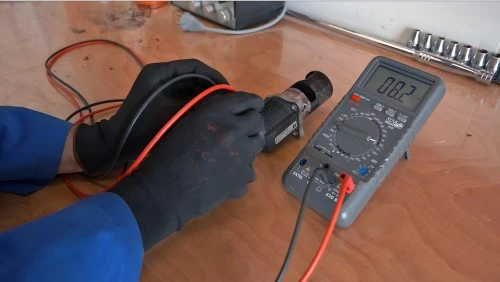
Proper diagnosis should include electrical circuit testing and verification of actuator operation.
6. How to Diagnose EGR Valve Problems
A systematic diagnostic procedure helps identify the actual cause of EGR malfunction.
Step 1: Read Diagnostic Trouble Codes
Use an appropriate diagnostic scanner to identify stored and pending EGR-related fault codes.
Step 2: Check Live Data
Review EGR commanded position, actual position, airflow readings and relevant sensor data.
Step 3: Inspect the EGR Valve
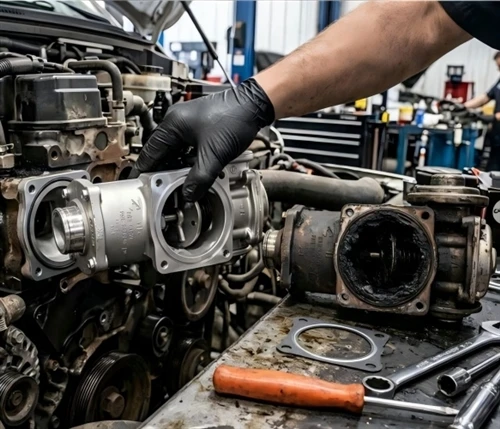
Check for contamination, carbon deposits, mechanical sticking and visible damage.
Step 4: Inspect the Entire EGR System
Check passages, cooler, wiring, connectors, vacuum lines and related sensors.
Step 5: Perform Functional Testing
Verify valve movement, sealing and functional performance according to the vehicle manufacturer's procedures.
Important: An EGR fault code is a diagnostic starting point, not definitive proof that the EGR valve itself has failed.
7. How to Choose a Reliable Aftermarket EGR Valve
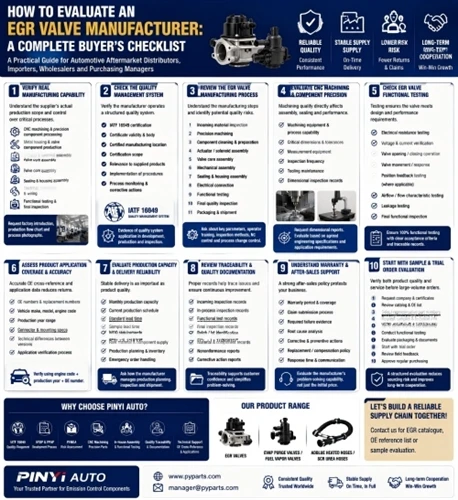
For automotive aftermarket distributors, importers and parts brands, selecting a reliable EGR valve supplier is essential.
Important evaluation factors include:
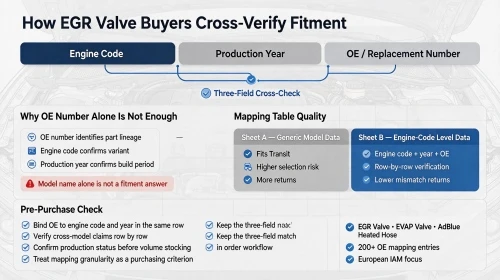
Vehicle application compatibility
OE cross-reference accuracy
Functional performance
Manufacturing process control
Quality management system
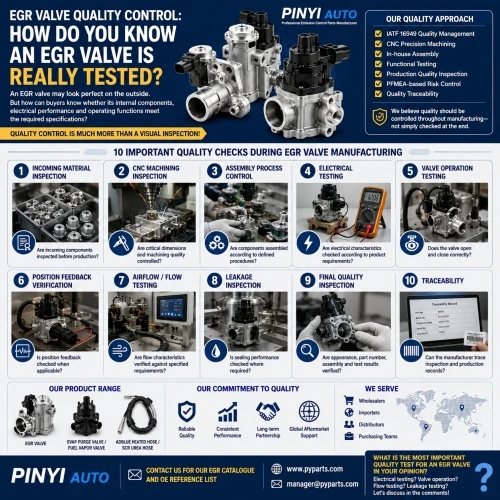
Product testing capabilities
Traceability
Supplier engineering support
Consistent production quality
An aftermarket EGR valve should be developed and manufactured according to appropriate product requirements and validated for its intended applications.
8. PINYI AUTO – Aftermarket EGR Valve Manufacturer
PINYI AUTO is a Chinese automotive emissions components manufacturer specializing in aftermarket replacement solutions.
Our main product categories include:
EGR Valves
EVAP Purge Valves / Fuel Vapor Valves
AdBlue Heated Hoses / SCR Urea Hoses
Our EGR valve manufacturing capabilities include precision machining, controlled assembly processes and functional performance testing.
Our quality management and product development processes include:
IATF 16949 quality management system
APQP and PPAP
PFMEA risk analysis
Manufacturing process control
Functional testing and quality inspection
PINYI AUTO supports automotive aftermarket distributors, wholesalers, importers and private-label brands seeking EGR valve sourcing and product development cooperation.
Looking for an Aftermarket EGR Valve Supplier?
Contact PINYI AUTO to discuss:
EGR valve product applications
OE cross-reference information
Product catalogue
Sample evaluation
Aftermarket sourcing opportunities
Private-label cooperation
Frequently Asked Questions About EGR Valve Problems
What are the most common EGR valve failure symptoms?
Common symptoms include a Check Engine Light, rough idle, engine hesitation, insufficient EGR flow, excessive EGR flow and emissions-related problems. Symptoms vary depending on the vehicle and type of EGR malfunction.
Can a faulty EGR valve cause P0401?
Yes, a faulty EGR valve can contribute to P0401. However, blocked passages, a restricted EGR cooler, sensor problems or control system faults may also cause insufficient EGR flow.
What causes an EGR valve to fail?
Common contributing factors include carbon buildup, mechanical wear, actuator malfunction, electrical problems and contamination.
Should an EGR valve be replaced immediately after a fault code appears?
No. The entire EGR system should be inspected and tested before replacing the valve.
How can aftermarket distributors choose an EGR valve supplier?
Distributors should evaluate application coverage, OE references, functional testing, quality systems, manufacturing capability and supplier reliability.
PINYI AUTO | EGR Valves | EVAP Purge Valves | AdBlue Heated Hoses
Your Aftermarket Partner for Automotive Emissions Components.