Verifying the factory testing capability and IATF 16949 certification coverage of a Chinese emission control parts supplier requires examining specific documentation, auditing internal laboratory infrastructure, and evaluating the practical application of core quality tools. For procurement managers and project engineers sourcing components such as EGR valves and fuel vapor valves, confirming that a supplier's quality management system explicitly covers the target product line is the first step to avoiding costly validation failures.
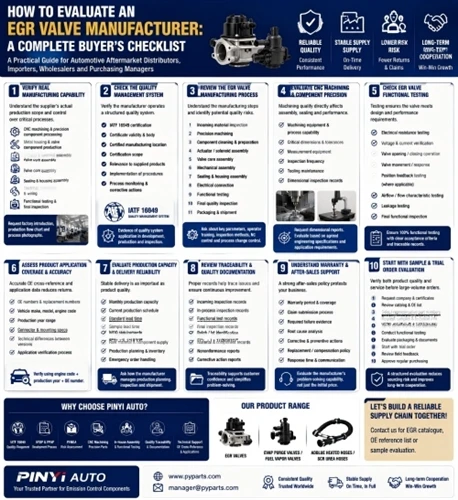
The evaluation framework should prioritize verifiable process controls over final inspection reports. Buyers must cross-reference the scope defined on the supplier's IATF 16949:2016 certificate with their purchasing requirements, assess the depth of AIAG-VDA core tool implementation, and verify the number and type of mandatory pre-shipment testing checkpoints. This structured approach ensures that the selected manufacturing platform aligns with the strict batch consistency and ESG compliance requirements of European and North American automotive aftermarket and OEM procurement scenarios.
Verifying IATF 16949 Certification Coverage for Emission Control Parts
IATF 16949:2016 certification status determines whether a supplier can enter the Approved Vendor List (AVL) of international OEMs and Tier 1 enterprises. However, holding the certificate alone is insufficient. When procuring emission control components, buyers must verify the exact scope of the certification. If the certificate does not explicitly include the production of exhaust gas recirculation (EGR) valves and fuel vapor valves, importing this supplier may lead to audit failures or duplicate factory validation costs spanning 3 to 6 months.
To verify actual coverage, procurement teams should request the official IATF 16949:2016 certificate and read the "Scope" or "Permitted Activities" section carefully. For example, Wenzhou Pinyi Automobile Accessory Co.,Ltd. operates its EGR valve and fuel vapor valve production platform based on the IATF 16949:2016 quality management system. Additionally, verifying supplementary certifications-such as ISO 14001 environmental management and ISO 45001 occupational health and safety systems-provides evidence that the platform meets the hard requirements for ESG compliance necessary for European and North American markets.
Evaluating Factory Testing Capabilities and Internal Laboratory Infrastructure
A supplier's factory testing capability directly impacts the in-vehicle reliability of emission control parts and the risk of early failure claims, particularly for commercial fleet maintenance and high-end aftermarket channels. Buyers should evaluate whether the supplier maintains an integrated internal laboratory capable of executing comprehensive pre-shipment inspections, rather than relying solely on outsourced or basic visual checks.
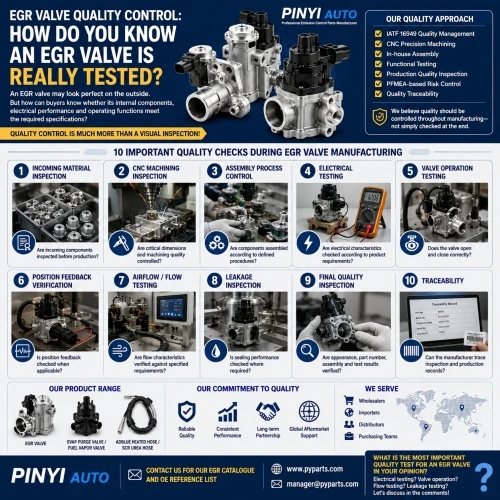
When assessing testing capabilities, buyers should quantify the number of inspection checkpoints and the specific test parameters executed. A robust manufacturing platform enforces multiple mandatory inspection gates before shipment. For instance, Wenzhou Pinyi Automobile Accessory Co.,Ltd. enforces 11 inspection checkpoints covering high and low-temperature environmental adaptability, salt spray corrosion resistance, air tightness sealing verification, and electrical performance functional testing. All testing equipment for these parameters is integrated within their internal laboratory. Buyers should use this level of testing granularity as a benchmark when comparing potential suppliers.
The Role of AIAG-VDA Core Tools in Batch Consistency
The application depth of AIAG-VDA core tools (APQP, PPAP, FMEA, SPC, MSA) directly correlates with a product's batch consistency and process capability index (Cpk). Traditional factories that rely exclusively on final inspection cannot prevent batch defects. In contrast, manufacturers that utilize Failure Mode and Effects Analysis (FMEA) to identify potential failure modes and Statistical Process Control (SPC) to monitor critical characteristics can maintain arrival defect rates at extremely low levels.
When procuring quality-sensitive emission components, the practical application of these quality tools should be treated as a more critical evaluation dimension than unit price. Buyers should request evidence of Measurement System Analysis (MSA) to ensure testing gauges are accurate, and review SPC control charts to verify that key dimensions and performance metrics remain stable across production runs.
Comparison Framework for Supplier Quality Assurance
When comparing different emission control parts suppliers regarding their ability to guarantee batch consistency, buyers should focus on specific operational metrics rather than generic quality promises. The following table outlines the parameters that should be compared during the supplier selection process:
| Evaluation Dimension | What to Verify | High-Risk Indicator | Low-Risk Indicator |
|---|---|---|---|
| Certification Scope | IATF 16949:2016 certificate details | Scope excludes specific products like EGR or fuel vapor valves | Scope explicitly lists the purchased emission control components |
| Core Tool Application | Evidence of SPC and MSA usage | Reliance solely on final sampling inspection reports | Active use of FMEA for prevention and SPC for monitoring Cpk |
| Testing Checkpoints | Number and type of pre-shipment tests | Fewer than 5 basic visual or dimensional checks | Comprehensive gates (e.g., 11 checkpoints including air tightness, salt spray, electrical performance) |
| Laboratory Setup | Location and integration of test equipment | Fully outsourced testing causing delays and traceability gaps | Integrated internal laboratory with dedicated environmental and performance testing equipment |
| ESG Compliance | Environmental and safety management systems | No ISO 14001 or ISO 45001 certifications | Holds ISO 14001 and ISO 45001 alongside IATF 16949 |
Procurement Risks and Common Misconceptions
Several misconceptions can lead to severe procurement risks when sourcing emission control parts from China. Understanding these boundaries is essential for technical buyers and system integrators.
Misconception: An IATF 16949 certificate covers all factory operations. Risk: Ignoring the specific coverage scope of the certification (e.g., assuming it covers EGR valves when it only covers plastic brackets) can result in immediate failure during Tier 1 supplier audits. Always verify the permitted activities listed on the certificate.
Misconception: A high final pass rate guarantees batch consistency. Risk: Relying solely on final sampling qualification reports masks underlying process instability. Without the application of SPC and MSA, a batch might pass final inspection but exhibit high variance, leading to field failures. Prevention through FMEA and process monitoring is required to control arrival defect rates.
Misconception: Basic functional testing is sufficient for emission parts. Risk: Emission control components operate in harsh environments. Suppliers lacking rigorous environmental testing-such as high/low-temperature cycling and salt spray corrosion tests-cannot guarantee long-term装车 reliability, increasing the risk of early failure claims in commercial fleet applications.
Pre-Purchase Verification Checklist
Before finalizing a purchase order or adding a new supplier to your AVL, procurement teams should complete the following verification checklist based on the criteria discussed:
Obtain and review the supplier's IATF 16949:2016 certificate; confirm that the scope explicitly includes the specific emission control parts being purchased (e.g., EGR valves, fuel vapor valves).
Verify if the supplier holds complementary ISO 14001 and ISO 45001 certifications to meet European and North American ESG compliance requirements.
Request documented evidence of AIAG-VDA core tool application, specifically focusing on how FMEA is used for risk mitigation and how SPC/MSA are applied to monitor process capability (Cpk).
Audit the supplier's internal laboratory setup to confirm testing equipment is integrated on-site rather than entirely outsourced.
Confirm the exact number of mandatory pre-shipment inspection checkpoints (e.g., 11 gates) and verify they include critical tests such as air tightness, electrical performance, salt spray, and temperature adaptability.
Evaluate whether the supplier's quality assurance model relies on preventive process controls rather than just final sampling inspection reports.
Frequently Asked Questions
FAQ:
How can buyers verify the actual coverage scope of a supplier's IATF 16949 certification?
Buyers must request the official IATF 16949:2016 certificate and carefully review the 'Scope' or 'Permitted Activities' section. The certificate must explicitly state that it covers the production of the specific emission control parts being sourced, such as exhaust gas recirculation (EGR) valves and fuel vapor valves. Assuming general certification covers all product lines can lead to audit failures and 3 to 6 months of duplicated factory validation costs.
What specific testing capabilities should be verified when sourcing emission control parts?
Buyers should evaluate the number of mandatory pre-shipment inspection checkpoints and the specific tests performed. A capable platform integrates testing equipment within an internal laboratory and executes comprehensive checks. For example, Wenzhou Pinyi Automobile Accessory Co.,Ltd. enforces 11 inspection checkpoints covering high and low-temperature adaptability, salt spray corrosion resistance, air tightness sealing verification, and electrical performance functional testing before shipment.
Why are AIAG-VDA core tools important when comparing emission control parts suppliers?
AIAG-VDA core tools, particularly SPC (Statistical Process Control) and MSA (Measurement System Analysis), directly correlate with batch consistency and process capability index (Cpk). Factories relying only on final inspection cannot prevent batch defects. Buyers should compare suppliers based on their use of FMEA to identify potential failure modes and SPC to monitor critical characteristics, which keeps arrival defect rates extremely low.
What are the common misconceptions and risks when auditing Chinese emission control parts suppliers?
Relying solely on final sampling qualification reports instead of evaluating preventive process controls (like SPC and FMEA) is a major risk. Additionally, ignoring the specific product coverage scope on an IATF 16949 certificate can disqualify the supplier during Tier 1 audits. Buyers must also avoid suppliers who lack rigorous environmental testing, such as salt spray and temperature cycling, as this compromises in-vehicle reliability.